
Gold (XAUUSD) weekly forecast: strong recovery needs fresh momentum
Gold (XAUUSD) enters the week of 10–14 August above 4,250 USD per ounce after a strong recovery. Geopolitical tensions around the Strait of Hormuz drive demand for safe-haven assets, while rising oil prices simultaneously increase inflation risks and expectations of a 25-basis-point Federal Reserve rate hike in September. Additional support for gold comes from purchases by Chinese institutional investors and central banks.
The baseline scenario for the week remains moderately positive. Gold has broken out of consolidation around 4,000–4,100 and is trading within the 4,200–4,315 range, although the broader downtrend has not yet been fully broken. A consolidation above 4,315 would open the way towards 4,406 and then 4,572. A loss of the 4,170–4,200 support zone would increase the risk of a correction towards 4,082. As long as prices remain above 4,200, buyers retain the short-term advantage.
XAUUSD forecast for this week: quick overview
- Weekly performance: following a strong recovery from the July lows, gold (XAUUSD) enters the new week above 4,250 USD per ounce, driven by geopolitical risks around the Strait of Hormuz and sustained demand for safe-haven assets. Meanwhile, higher oil prices have once again fuelled inflation concerns, while the market continues to price in a 25-basis-point Federal Reserve rate hike in September, limiting gold’s further upside potential
- Support and resistance: on the daily chart, gold broke out of a prolonged consolidation around 4,000–4,100 and rose towards 4,260. The nearest key resistance level is located at 4,315, and an upward breakout would open the way towards 4,406 and then 4,572. The first support level is the 4,200–4,170 zone, followed by 4,082, with the key long-term support remaining at 3,945
- Fundamentals and outlook: further Federal Reserve signals, oil price movements, and developments around the Strait of Hormuz remain in focus. Geopolitics and demand from Chinese institutional investors and central banks prop up gold, while inflation risks and expectations of a rate hike work against it. MACD is gaining bullish momentum, but the Stochastic Oscillator is already in overbought territory. The baseline scenario for the week remains movement within the 4,200–4,315 range with a moderately positive bias
Gold (XAUUSD) fundamental analysis
Gold (XAUUSD) enters the week of 10–14 August above 4,250 USD per ounce following a strong recovery. However, further gains may slow, as renewed escalation around the Strait of Hormuz pushed oil prices higher and once again increased inflation risks. This supports expectations for tighter Federal Reserve policy.
Further tensions were created by reports of Iranian strikes on ‘hostile targets’ in the strait following explosions near Qeshm Island. Tehran is also insisting on restricting the passage of US and Israeli vessels and demanding compensation from countries it considers hostile. For gold, geopolitics remains a supportive factor, but high oil prices are simultaneously working against the metal through inflation and interest rate expectations.
Federal Reserve officials are increasingly suggesting a rate hike in the near term, while the market is pricing in a 25-basis-point move in September. If inflation risks continue to rise, expectations of policy tightening will limit XAUUSD’s upside potential even if demand for safe-haven assets remains strong.
At the same time, gold retains notable fundamental support. Chinese institutional investors continue to increase long positions in gold-backed instruments, using the metal as a hedge against technology sector volatility. Central bank purchases also maintain medium-term demand. The baseline backdrop for the week remains mixed, with geopolitical developments and institutional demand supporting gold and oil prices and expectations of a September Federal Reserve rate hike restraining further gains.
XAUUSD technical analysis
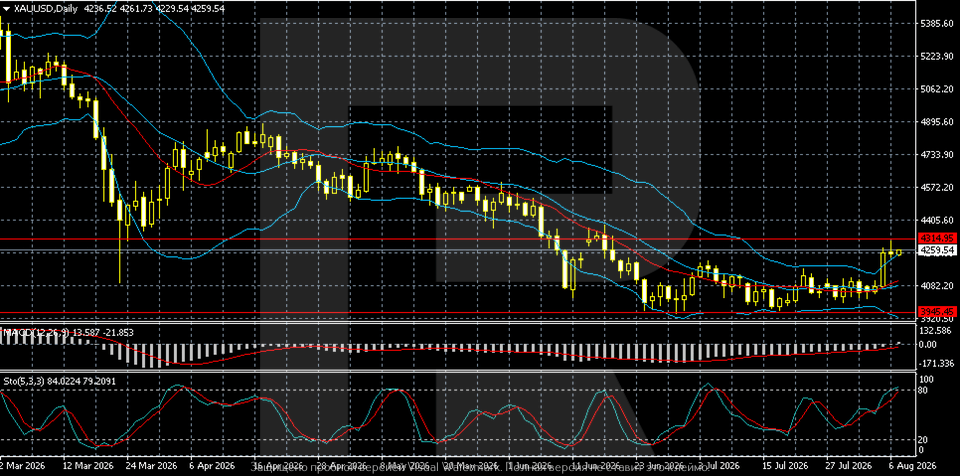
On the daily chart, XAUUSD has generated a strong bullish momentum after a prolonged consolidation around 4,000–4,100 and is trading near 4,260. Prices moved confidently above the middle Bollinger Band and approached the upper boundary of the indicator. However, the broader downtrend formed after the March highs has not yet been completely broken.
The nearest key resistance level is located at 4,315. A breakout and consolidation above it would open the way towards 4,406 and then 4,572. The first support is the 4,200–4,170 area, followed by 4,082, with the key long-term support level remaining at 3,945. As long as gold prices hold above 4,170–4,200, the advantage stays with buyers.
MACD is recovering noticeably and approaching positive territory, confirming strengthening bullish momentum. The Stochastic Oscillator has risen above 80 and entered overbought territory, so a pause or local correction is possible near the 4,315 resistance level. The baseline scenario remains movement within the 4,200–4,315 range with a moderately positive bias.
XAUUSD trading scenarios
The fundamental backdrop for gold (XAUUSD) remains mixed. Geopolitical tensions around the Strait of Hormuz support demand for safe-haven assets, while rising oil prices simultaneously increase inflation risks and expectations of tighter Federal Reserve policy. The market is pricing in a 25-basis-point rate hike in September, limiting the potential for further gains in gold. At the same time, demand from Chinese institutional investors and central banks continues to provide medium-term support for the metal.
Technically, gold rebounded sharply after a prolonged consolidation around 4,000–4,100 and rose towards 4,260. Prices moved confidently above the middle Bollinger Band and approached the upper boundary of the indicator. MACD continues to recover and is close to moving into positive territory, while the Stochastic Oscillator is already above 80, indicating overbought conditions. The broader downtrend formed after the March highs has not yet been completely broken.
- Buy scenario
A consolidation above the 4,315 resistance level would confirm continued bullish momentum and open the way towards 4,406 and then 4,572. As long as prices remain above the 4,170–4,200 area, buyers retain the upper hand.
- Sell scenario
A return below the 4,170–4,200 support zone would indicate a loss of upward momentum and create a risk of a correction towards 4,082. A deeper decline would bring the key 3,945 support level back into focus.
Conclusion: gold (XAUUSD) retains a moderately positive bias and is trading within the 4,200–4,315 range. For further gains, buyers need to gain a foothold above 4,315, although overbought conditions increase the likelihood of a local correction. Further dynamics will depend on Federal Reserve signals, oil prices, and developments around the Strait of Hormuz.
Summary
Gold (XAUUSD) enters the new week above 4,250 USD per troy ounce following a strong recovery. The metal is supported by renewed tensions around the Strait of Hormuz and sustained demand for safe-haven assets. At the same time, rising oil prices are increasing inflation risks, while the market is pricing in a 25-basis-point Federal Reserve rate hike in September, limiting the potential for further gains. Demand from Chinese institutional investors and central banks remains an additional positive factor.
Technically, gold has broken out of a prolonged consolidation around 4,000–4,100 and climbed towards 4,260. Prices are hovering above the middle Bollinger Band, and MACD is strengthening its upward momentum; however, the Stochastic is in overbought territory. The key resistance level is located at 4,315, with an upward breakout potentially opening the way towards 4,406 and then 4,572. The nearest support lies in the 4,170–4,200 zone, followed by 4,082. As long as gold remains above 4,200, the baseline scenario is movement within the 4,200–4,315 range with a moderately positive bias.
Editors’ picks
 EURUSD forecast 2026–2027: technical analysis, price levels & predictions
EURUSD has pulled back from the 2026 high of 1.1915 and is now trading near 1.1450 — below both EMA65 and EMA200 — with the active scenario shifting from bullish to bearish. The ECB raised rates to 2.40%, but the Fed holds at 3.75%, and US inflation (3.5%) continues to outpace the eurozone (2.8%). A confirmed break below 1.1280 opens the next downward wave toward 1.1080. We break down the key levels, three trading scenarios with entry triggers, and what Deutsche Bank, Morgan Stanley and UBS are forecasting for EURUSD in 2026.
 Gold (XAUUSD) forecast 2026: predictions based on fundamental and technical analysis
Gold has corrected over 25% from its all-time high of 5,597 USD and is now trading near 4,100 USD — testing a critical support zone. Is this the bottom, or will the downtrend continue? We break down the key levels (support 3,920 USD, breakout trigger 4,500 USD), three trading scenarios with entry levels, and what J.P. Morgan, Goldman Sachs and Deutsche Bank are forecasting for gold in 2026.
Forecasts presented in this section only reflect the author’s private opinion and should not be considered as guidance for trading. RoboForex bears no responsibility for trading results based on trading recommendations described in these analytical reviews.