
USDJPY declines after failing to hold above 157.95
The USDJPY pair is declining amid a stronger yen and a weaker US dollar, with the rate currently at 157.54. Discover more in our analysis for 10 March 2026.
USDJPY forecast: key takeaways
- Falling energy prices reduced pressure on Japan’s economy, which remains a major oil importer
- Easing geopolitical tensions amid expectations of an end to the war with Iran dampened demand for the US dollar as a safe-haven asset
- Japan’s economy grew by 0.3% quarter-on-quarter in Q4 2025 based on the government’s revised data
- USDJPY forecast for 10 March 2026: 155.10
Fundamental analysis
The USDJPY rate is declining for the second consecutive session. Buyers failed to consolidate above the 157.95 resistance level, increasing downside pressure on the pair. The Japanese yen found support as falling energy prices reduced the burden on Japan’s economy, which remains a major oil importer. The yen also benefitted from a weaker US dollar. Easing geopolitical tensions amid hopes of a swift end to the war with Iran reduced demand for the US currency as a safe-haven asset.
Diminishing inflation concerns strengthened expectations of monetary easing by the Federal Reserve. Markets are pricing in two 25-basis-point rate cuts by the end of the year, with July and September seen as the most likely timing.
Japan’s economy is showing signs of recovery. Revised data indicated Japan’s GDP grew by 0.3% quarter-on-quarter in Q4 2025. The preliminary estimate pointed to 0.1% growth, while analysts expected the revision to 0.3%. In Q3, Japan’s economy had contracted by 0.7%.
Technical outlook
The USDJPY pair is falling after rebounding from the upper boundary of the bullish channel. Buyers failed to gain a foothold above 157.95, which indicates increasing selling pressure. Today’s USDJPY forecast suggests the decline may continue, with the nearest target at 155.10.
The technical picture is gradually shifting in favour of the bears. The Stochastic Oscillator signals strengthening downside pressure: readings reached overbought territory and formed a bearish crossover, signalling an elevated risk of a corrective drop. A decisive breakout below the lower boundary of the bullish channel, with consolidation beneath 157.05, will further confirm the main scenario. Such a signal would increase the probability of a sustained downward move.
The alternative scenario suggests a breakout above the upper boundary of the bullish channel with consolidation above 159.10. This outcome would indicate weakening selling pressure and raise the likelihood of a renewed upward move.
USDJPY overview
- Asset: USDJPY
- Timeframe: H4 (Intraday)
- Trend: bullish with a risk of correction
- Key resistance levels: 157.65 and 158.25
- Key support levels: 157.35 and 155.35
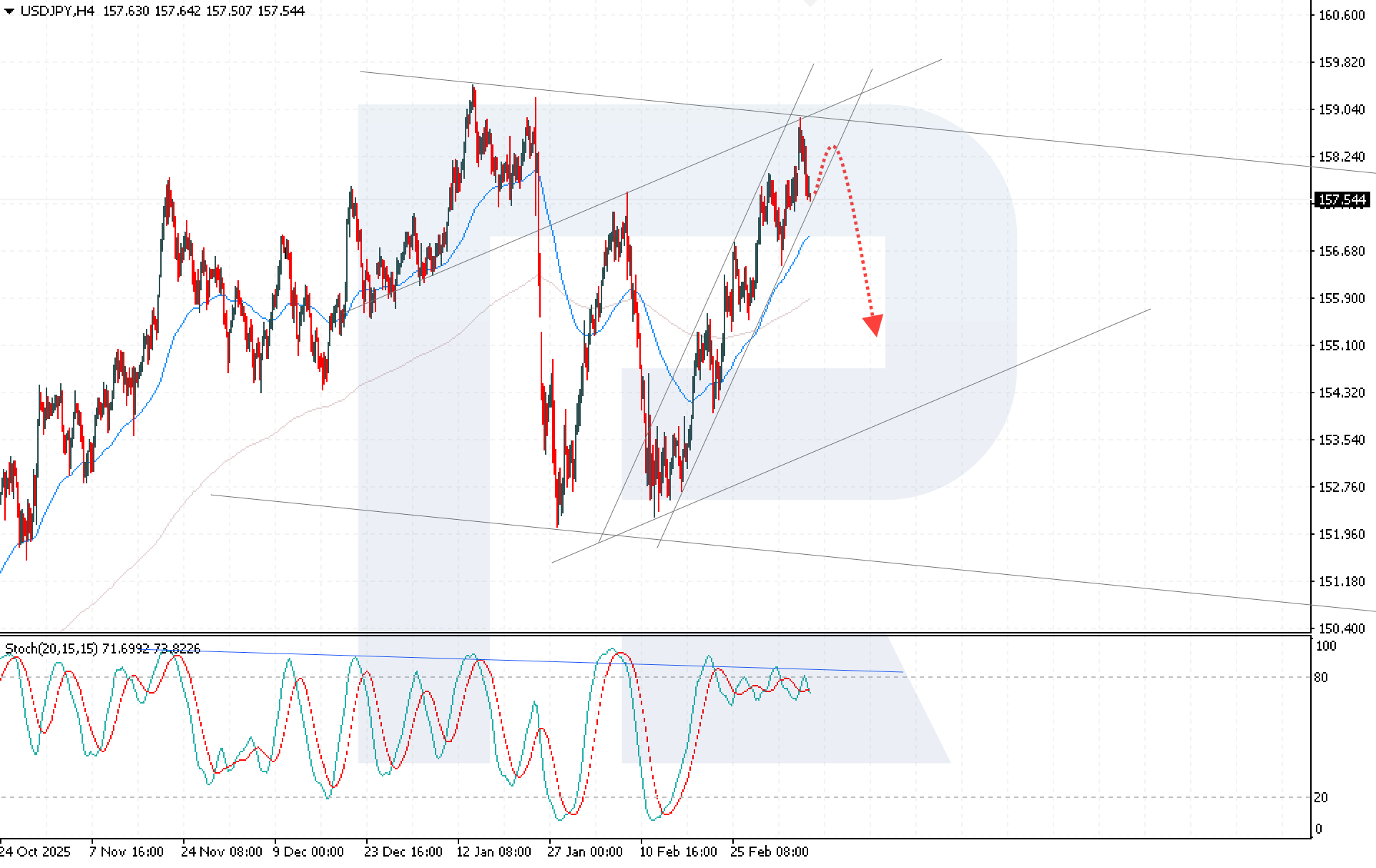
USDJPY trading scenarios for today
Main scenario (Sell Stop)
A breakout and consolidation below 157.35 would confirm a move outside the bullish channel, creating conditions for opening short positions. The move potential is about 225 pips with a risk of around 35 pips. The risk-to-reward ratio exceeds 1:6.
- Take Profit: 155.10
- Stop Loss: 157.70
Alternative scenario (Buy Stop)
A consolidation above 159.10 would increase corrective pressure and may trigger a test of a deeper support level.
- Take Profit: 159.95
- Stop Loss: 158.65
Risk factors
Rising energy prices or heightened geopolitical tensions could weaken the yen and support the USDJPY pair. An additional risk to the downside scenario would be strong US macroeconomic data, which could reduce expectations of Federal Reserve policy easing and strengthen the US dollar.
Summary
The USDJPY decline is driven by a stronger yen amid falling energy prices, a weaker US dollar, and rising expectations of US rate cuts. The USDJPY forecast suggests downside pressure may persist, with a risk of a move towards 155.10.
Editors’ picks
 EURUSD 2026-2027 forecast: key market trends and future predictions
This article provides the EURUSD forecast for 2026 and 2027 and highlights the main factors determining the direction of the pair’s movements. We will apply technical analysis, take into account the opinions of leading experts, large banks, and financial institutions, and study AI-based forecasts. This comprehensive insight into EURUSD predictions should help investors and traders make informed decisions.
 Gold (XAUUSD) forecast 2026 and beyond: expert insights, price predictions, and analysis
Dive deep into the Gold (XAUUSD) price outlook for 2026 and beyond, combining technical analysis, expert forecasts, and key macroeconomic factors. It explains the drivers behind gold’s recent surge, explores potential scenarios including a move toward 4,500 to 5,000 USD per ounce, and highlights why the metal remains a strong hedge during global uncertainty.
Forecasts presented in this section only reflect the author’s private opinion and should not be considered as guidance for trading. RoboForex bears no responsibility for trading results based on trading recommendations described in these analytical reviews.