
EURUSD weekly forecast: recovery after the June decline
The EURUSD pair enters the week of 13–17 July near 1.1441 amid a weakening dollar. Easing geopolitical tensions and falling oil prices bolstered the euro, but the market still expects at least one Federal Reserve rate hike before the end of the year. The key event of the new week will be the release of the US June CPI, which may change expectations regarding the Federal Reserve’s future policy.
Technically, the EURUSD pair remains in a recovery phase after the June decline. The price is hovering above 1.1400 but is yet to break above the 1.1450–1.1470 resistance area, with a breakout likely to open the way to 1.1580. A loss of the 1.1400 support level will increase the likelihood of a decline towards 1.1330.
EURUSD forecast for this week: quick overview
- Market focus: the EURUSD pair ended the week around 1.1441 amid a weaker US dollar. Pressure on the US currency eased after reports of continued peace talks between the US and Iran, which reduced demand for safe-haven assets. Lower oil prices provided additional support for the euro by reducing inflation concerns. However, the market is still pricing in at least one Federal Reserve rate hike before the end of the year
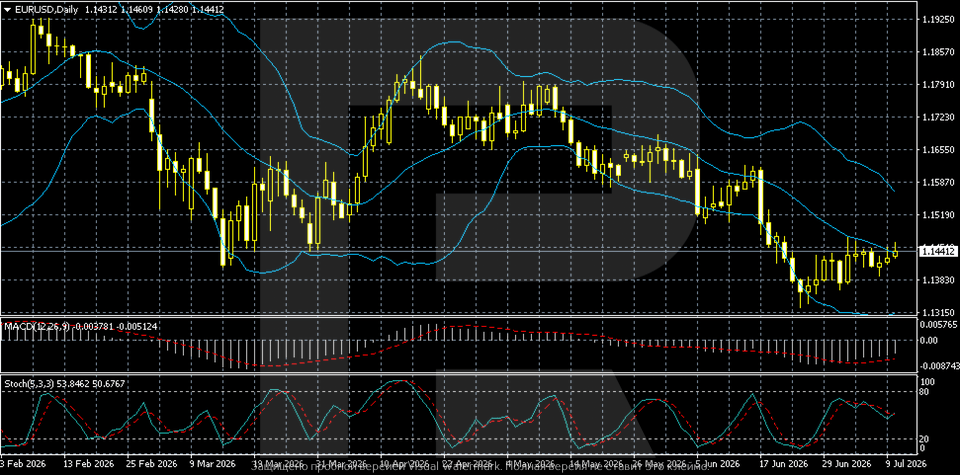
- Current trend: on the daily chart, the EURUSD pair continues to recover after the June decline. The price has consolidated above 1.1400, although growth slowed near the middle Bollinger Band in the 1.1450–1.1470 zone. MACD remains in negative territory but is gradually reducing the extent of its decline, reflecting a weakening of the bearish momentum. The Stochastic Oscillator is turning upwards, signalling a gradual recovery in demand
- Weekly outlook: the main event will be the release of the June US Consumer Price Index (CPI), which may significantly adjust expectations for the Federal Reserve’s future policy. The baseline scenario suggests continued consolidation with an attempt to extend the recovery above 1.1470. If the pair successfully breaks above this zone, the next target will be 1.1580. If the pair retreats below 1.1400, the risks of another decline towards the key support level at 1.1330 will increase
EURUSD fundamental analysis
The EURUSD pair closed the week near 1.1441. Pressure on the US currency increased following reports that the US and Iran would continue peace talks despite the recent escalation of the conflict. Easing geopolitical tensions reduced demand for the dollar as a safe-haven asset.
Falling oil prices further supported dollar sellers, reducing inflation fears and slightly lowering expectations for further Fed policy tightening. Nevertheless, the market still expects at least one interest rate hike before the end of the year.
Federal Reserve officials were also in the spotlight last week. New York Fed President John Williams said that one of the key drivers of inflation remains demand growth driven by artificial intelligence. Federal Reserve Chairman Kevin Warsh, in turn, announced the creation of five task forces to review the regulator’s key areas of activity, which may lead to changes in the approach to monetary policy.
This week, the main event for the currency market will be the release of the June US Consumer Price Index. Inflation data may adjust expectations for the Fed’s next steps and determine the direction of the dollar in the second half of July.
EURUSD technical analysis
On the daily chart, the EURUSD pair formed a recovery phase after a sharp decline towards the 1.1330 area. Buyers managed to return quotes above 1.1400, although growth slowed near the middle Bollinger Band, where the pair again encountered resistance. The EURUSD rate is now consolidating around 1.1440, awaiting new fundamental drivers.
The technical picture is gradually improving, but it is too early to discuss a full-fledged trend reversal. The nearest resistance level is located in the 1.1450–1.1470 area, where the middle Bollinger Band passes. A confident breakout above it would open the door for a recovery towards 1.1580. The support level lies at 1.1400, with a stronger one near 1.1330, where a local low previously formed.
Indicators are giving mixed signals. MACD remains in negative territory, although the histogram is reducing the depth of the decline, indicating waning bearish momentum. The Stochastic Oscillator has turned upwards and is approaching the neutral area, reflecting a gradual recovery in demand. As long as the EURUSD pair holds above 1.1400, the baseline scenario remains consolidation with an attempt to develop an upward correction.
EURUSD trading scenarios
The EURUSD pair ended the week around 1.1441. Lower oil prices provided additional support for the euro by reducing inflation concerns. The market still expects at least one Federal Reserve rate hike before the end of 2026. The key event of the coming week will be the release of the June US CPI data, which may change expectations regarding the Federal Reserve’s future policy.
From a technical perspective, the EURUSD rate remains in a corrective recovery phase after the June decline. The pair is holding above 1.1400, although growth slowed around 1.1450–1.1470, where the middle Bollinger Band lies. MACD remains in negative territory but is reducing the depth of decline, signalling a weakening bearish momentum. The Stochastic Oscillator is turning upwards, reflecting a gradual recovery in demand.
- Buy scenario
Consolidation above 1.1470 would open potential for a continued recovery, with the nearest target around 1.1580.
- Sell scenario
A return below 1.1400 would add to pressure on the pair and increase the likelihood of a retest of the key support level at 1.1330.
Conclusion: the technical picture for the EURUSD pair is gradually improving, although it remains premature to discuss a full-fledged medium-term trend reversal. The pair’s direction in the coming week will largely depend on US inflation data and its impact on expectations regarding the Federal Reserve’s future actions.
Summary
The EURUSD pair closed the week rising to 1.1441. In the coming week, the key highlight will be the release of the June US CPI data, which may adjust expectations for the US regulator’s next steps.
Technically, the EURUSD pair remains in a corrective recovery phase following its decline in June. The price is hovering above 1.1400; however, growth slowed around 1.1450–1.1470, where the middle Bollinger Band runs, so it remains premature to discuss a full-fledged reversal. A confident breakout above this zone will open the way to 1.1580, while the 1.1330 area remains key support.
Editors’ picks
 EURUSD forecast 2026–2027: technical analysis, price levels & predictions
The ECB holds rates at 2.15% while the Fed stays at 3.75% — and that divergence is the central driver of EURUSD in 2026. The pair is range-bound between 1.1400 and 1.1915, with Deutsche Bank targeting 1.2500 and Morgan Stanley calling for 1.3000 by year-end. We analyse the technicals, break down the macro factors, and outline three trading scenarios with specific entry levels.
 Gold (XAUUSD) forecast 2026: predictions based on fundamental and technical analysis
Gold has corrected over 25% from its all-time high of 5,597 USD and is now trading near 4,100 USD — testing a critical support zone. Is this the bottom, or will the downtrend continue? We break down the key levels (support 3,920 USD, breakout trigger 4,500 USD), three trading scenarios with entry levels, and what J.P. Morgan, Goldman Sachs and Deutsche Bank are forecasting for gold in 2026.
Forecasts presented in this section only reflect the author’s private opinion and should not be considered as guidance for trading. RoboForex bears no responsibility for trading results based on trading recommendations described in these analytical reviews.