
EURUSD on the verge of disaster: Europe in an energy trap
Rising inflation in the eurozone is causing the euro to lose ground, with the rate currently standing at 1.1460. Find more details in our analysis for 31 March 2026.
EURUSD forecast: key takeaways
- Eurozone Consumer Price Index (CPI) for March: previously at 1.9%, projected at 2.6%
- Inflation in Germany jumped to 2.8% in March
- Inflation in Spain accelerated to 3.3%
- EURUSD forecast for 31 March 2026: 1.1410
Fundamental analysis
The EURUSD forecast takes into account that today the price is forming a downward wave and trading around 1.1460.
The European Union Consumer Price Index reflects changes in the cost of goods and services for consumers, which helps assess consumer demand dynamics and the degree of stagnation in the economy. A higher-than-expected reading could have a positive effect on the euro.
The EURUSD forecast for 31 March 2026 suggests that the index may rise to 2.4% from the previous 1.9%. The forecast reading does not differ critically from the previous one, but if the actual figure improves, it may strengthen the euro.
The main driver for the euro today is the inflation shock that is literally tearing the eurozone economy apart from within:
- Germany is the epicentre of the storm: yesterday, 30 March, data came out that made the market shudder. Inflation in Germany jumped to 2.8% year-on-year in March against 2.0% in February, marking the highest reading in the past year. The reason is obvious – high energy prices for oil and gas
- Chain reaction: following Germany, Spain also released its statistics, reporting inflation accelerating to 3.3%. Today, data from France and Italy will be released, along with the main indicator – the preliminary eurozone CPI for March. The forecast is grim: growth to 2.6%, which will mark the highest reading since July 2024
- ECB reaction: the market no longer doubts, and investors are pricing in at least three ECB rate hikes in 2026. Moreover, the first hike may come as early as the April meeting. ECB President Christine Lagarde has already promised to act quickly and decisively if necessary
The euro paradox: at first glance, high inflation = a rate hike = a strong currency. But there is a catch. Europe is an energy importer, so high oil prices, with Brent trading around 105.00 USD, hit the eurozone economy much harder than the US economy, causing not only inflation but also the threat of stagflation, which means falling output plus rising prices. The head of the Bank of Greece has already warned about this risk.
While Europe is torn between inflation and recession, the situation in the US looks paradoxically comfortable. Federal Reserve Chairman Jerome Powell spoke yesterday at Harvard and made it clear: we can afford to look past a temporary spike in oil prices. He said US monetary policy is in a favourable position. This is a signal to the market: the Fed will not panic and raise rates because of oil, but it does not plan to cut them any time soon either.
The current energy crisis is hitting the euro much harder because the US, thanks to the shale revolution, has become almost energy independent. The dollar is benefitting from high oil prices for several reasons at once: it remains the main reserve currency and the main safe haven from risk.
Against this backdrop, a preliminary conclusion can be drawn that Europe has fallen into an energy trap. High oil prices mean inflation, which the ECB is forced to fight with rates, but they also mean damage to the economy. At the same time, the dollar feels comfortable and continues to strengthen.
Technical outlook
On the H4 chart, the EURUSD pair formed a Hammer reversal pattern near the lower Bollinger Band. At this stage, it may form a corrective wave following this signal, with the pullback target at 1.1520. A rebound from this level would open the door for a continued downtrend.
At the same time, today’s EURUSD forecast also suggests another scenario. Since the quotes remain within a descending channel, they may continue their downward movement, test the support level around 1.1410, and continue to decline.
EURUSD overview
- Asset: EURUSD
- Timeframe: H4 (Intraday)
- Trend: downward
- Key resistance levels: 1.1520 and 1.1615
- Key support levels: 1.1410 and 1.1320
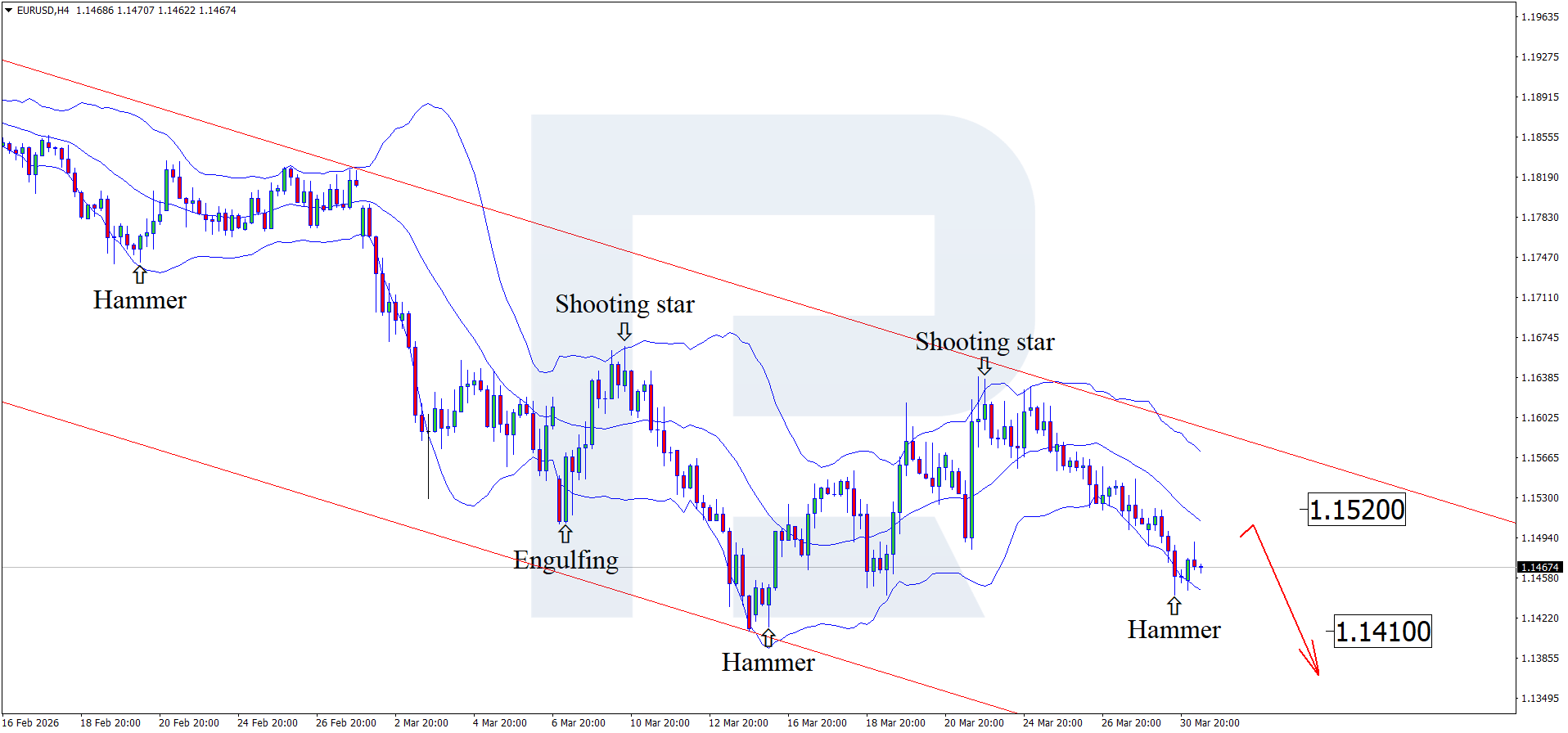
EURUSD trading scenarios for today
Main scenario (Sell Stop)
Consolidation below 1.1410 would indicate a breakout below the support level and create conditions for opening short positions.
- Take Profit: 1.1320
- Stop Loss: 1.1430
Alternative scenario (Buy Stop)
A breakout above the resistance level and consolidation above 1.1520 would strengthen buying pressure and indicate the formation of a corrective wave.
- Take Profit: 1.1615
- Stop Loss: 1.1495
Risk factors
The risks to a EURUSD decline are linked to a failure to break the local low and consolidate below 1.1410. An additional risk factor is an ECB interest rate hike and a weakening USD amid geopolitical tensions.
Summary
The euro is going through difficult times, and rising inflation in the eurozone may prompt the ECB to take decisive measures to strengthen the economy. EURUSD technical analysis suggests a correction towards 1.1520 before a decline.
Editors’ picks
 EURUSD 2026-2027 forecast: key market trends and future predictions
This article provides the EURUSD forecast for 2026 and 2027 and highlights the main factors determining the direction of the pair’s movements. We will apply technical analysis, take into account the opinions of leading experts, large banks, and financial institutions, and study AI-based forecasts. This comprehensive insight into EURUSD predictions should help investors and traders make informed decisions.
 Gold (XAUUSD) forecast 2026 and beyond: expert insights, price predictions, and analysis
Dive deep into the Gold (XAUUSD) price outlook for 2026 and beyond, combining technical analysis, expert forecasts, and key macroeconomic factors. It explains the drivers behind gold’s recent surge, explores potential scenarios including a move toward 4,500 to 5,000 USD per ounce, and highlights why the metal remains a strong hedge during global uncertainty.
Forecasts presented in this section only reflect the author’s private opinion and should not be considered as guidance for trading. RoboForex bears no responsibility for trading results based on trading recommendations described in these analytical reviews.