
UPS – shares trading in a descending channel: potential entry levels
UPS exceeded profit expectations and issued a moderately positive forecast for 2026, yet the shares remain in a descending channel. The base scenario assumes a test of support at 88 USD, with potential for a rebound towards 120 USD.
United Parcel Service (NYSE: UPS) delivered a strong Q4 2025 report, exceeding market expectations. Revenue reached 24.5 billion USD, operating income was 2.6 billion USD, operating margin stood at 10.5%, and non-GAAP EPS came in at 2.38 USD. This surpassed the consensus of around 24.0 billion USD in revenue and 2.20 USD EPS. While revenue declined year-on-year, business quality improved, driven by higher revenue per shipment and a more profitable order mix.
Segment performance was mixed. In the US, revenue fell 3.2%, but revenue per shipment increased by 8.3%. International operations performed better, with a 2.5% revenue rise, while Supply Chain Solutions remained weak.
The outlook for 2026 is moderately positive. UPS expects revenue of approximately 89.7 billion USD, with management anticipating improvement in the second half of the year as low-margin volumes decline and network operations normalise.
This article reviews United Parcel Service, Inc., outlining its revenue sources, summarising quarterly performance, and presenting expectations for the upcoming reporting period. A technical analysis of UPS shares is also included, forming the basis for the UPS stock forecast for the 2026 calendar year.
About United Parcel Service, Inc.
United Parcel Service (UPS) is the world’s largest logistics and courier company, specialising in freight and parcel delivery as well as logistics solutions. Founded in Seattle, US, by James E. Casey and Claude Ryan in 1907 as the American Messenger Company, it was renamed United Parcel Service in 1919 as operations expanded beyond Seattle. Its initial public offering took place on 10 November 1999 on the New York Stock Exchange under the ticker UPS. The company provides express parcel delivery across the US and globally, along with international logistics, contract logistics, supply chain management, and specialised solutions for a range of industries, including e-commerce, healthcare, and manufacturing. It is headquartered in Atlanta, Georgia. UPS’ primary competitors include FedEx (NYSE: FDX) and DHL (XETR: DHL), part of the Deutsche Post Group, along with regional and local delivery operators, including national postal services and new market entrants such as Amazon Logistics.

United Parcel Service, Inc.’s business model
UPS’s business model is built around a wide range of logistics and transportation services. The company’s revenue is derived from the following key segments:
- US Domestic Package (domestic delivery across the US): this is UPS’s primary revenue stream, comprising parcel delivery to individuals (B2C) and corporate clients (B2B) across the US. Revenue is generated through express delivery services, including UPS Next Day Air, as well as standard and economy options, with additional charges applied for overweight parcels, urgent shipments, and residential delivery.
- International Package (international shipments): this includes revenue from international parcel and freight deliveries worldwide, covering both export and import operations. UPS operates in over 220 countries, and the international division generates particularly high margins from the express delivery of documents and commercial shipments.
- Supply Chain Solutions (logistics and supply chain operations): this segment includes revenue from comprehensive logistics solutions, including contract logistics (warehousing, packaging, and inventory management), specialised solutions for healthcare, manufacturing, e-commerce and technology, LTL transportation services, ocean and air freight, as well as supply chain management and reverse logistics services.
- Surcharges and Value-Added Services: this category includes fuel surcharges, peak load charges, insurance, tracking, rerouting, and other related services that increase the average revenue per shipment.
Thus, UPS generates revenue through a diversified portfolio of logistics services, serving both the mass segment (retail clients) and the large corporate sector with tailored supply chain solutions.
United Parcel Service, Inc. Q1 2025 results
On 23 April 2025, UPS published its Q1 2025 financial results for the quarter ended 31 March 2025. Below is its key financial data compared to the corresponding period of last year:
- Revenue: 21.55 billion USD (–1%)
- Net income: 1.27 billion USD (+4%)
- Earnings per share: 1.49 USD (+4%)
- Operating margin: 8.20% (+20 basis points)
Revenue by segment:
- US Domestic Segment: 14.46 billion USD (+1%)
- Operating profit: 1.01 billion USD (+19%)
- International Segment: 4.37 billion USD (+3%)
- Operating profit: 654 million USD (–4%)
- Supply Chain Solutions: 2.71 billion USD (–15%)
- Operating profit: 98 million USD (–55%)
UPS’ Q1 fiscal 2025 report demonstrated the company’s agile adaptation to external challenges and its focused efforts to enhance operational efficiency and maintain profitability. With revenue down 1% to 21.5 billion USD, non-GAAP adjusted EPS was 1.49 USD, exceeding the consensus forecast by over 8%, confirming the stability of key business areas.
CEO Carol Tomé noted that UPS is undertaking the largest transformation of its logistics network in the company’s history, with plans to save 3.5 billion USD this year by closing 73 facilities and laying off 20,000 employees. This move enables the company to offset lower volumes, including a decline in orders from Amazon and tariff pressure on international shipments. UPS is adapting its structure to meet current demand, becoming more compact and efficient.
Although management did not update its full-year 2025 outlook due to macroeconomic uncertainty, particularly relating to tariffs, it provided guidance for Q2. Revenue is expected to reach 21 billion USD, with US parcel delivery volumes projected to decline by 9%. International margins are anticipated to remain in the mid-double-digit range (percentage terms). Margins in the US delivery segment are also forecast to rise by 30 basis points, supported by the impact of restructuring.
UPS is prioritising strict cost optimisation over revenue growth, and its Q2 guidance reflects a realistic, cautious stance amid ongoing uncertainty. If the company succeeds in implementing the planned 3.5 billion USD in savings, including potential further restructuring, it could emerge from the current cycle significantly more profitable and resilient.
United Parcel Service, Inc. Q2 2025 financial results
On 29 July 2025, UPS released its Q2 2025 financial results for the quarter ended 30 June 2025. The key financial metrics compared with the same period last year are as follows:
- Revenue: 21.22 billion USD (–3%)
- Net profit: 1.31 billion USD (–14%)
- Earnings per share: 1.55 USD (–13%)
- Operating margin: 8.80% (–60 basis points)
Revenue by segment:
- US Domestic Segment: 14.08 billion USD (–1%)
- Operating profit: 0.98 billion USD (–1%)
- International Segment: 4.49 billion USD (+3%)
- Operating profit: 682 million USD (–17%)
- Supply Chain Solutions: 2.65 billion USD (–18%)
- Operating profit: 212 million USD (–13%)
UPS reported Q2 FY2025 revenue of 21.2 billion USD and non-GAAP EPS of 1.55 USD. Sales exceeded analyst forecasts, but earnings came in slightly below consensus.
In the US, results were weaker: revenue declined, parcel volumes fell by 7%, and per-parcel delivery costs increased, weighing on margins. The international business presented the opposite picture: volume growth of nearly 4% and a profitability level of around 15% made this segment the strongest performer. The Supply Chain Solutions division was impacted by the sale of Coyote a year earlier, resulting in lower revenue. Free cash flow for the first half of the year was 742 million USD – sufficient to cover dividends and investment, while the company continues to build resilience through cost savings.
The main weak spots for UPS are declining volumes in the US, rising per-parcel costs, and the lingering impact of the Coyote divestment. Additional pressure comes from new tariffs on low-value parcels from China, which are weighing on budget marketplaces and last-mile delivery.
On the positive side, UPS maintains high margins in its international segment and is firmly implementing its optimisation program, which is expected to deliver around 3.5 billion USD in cost savings in 2025. The company is also reducing reliance on Amazon, accepting lower volumes in exchange for improved profitability.
While UPS does not provide quarterly guidance, it reaffirmed its full-year 2025 plan, which includes capital expenditures of approximately 3.5 billion USD, dividends of around 5.5 billion USD, and pension contributions of about 1.4 billion USD.
United Parcel Service, Inc. Q3 2025 financial results
On 28 October 2025, UPS released its Q3 2025 financial results for the quarter ended 30 September 2025. Key financial figures compared with the same period last year are as follows:
- Revenue: 21.42 billion USD (–4%)
- Net profit (non-GAAP): 1.48 billion USD (–2%)
- Earnings per share (non-GAAP): 1.74 USD (–1%)
- Operating margin: 10.00% (+110 basis points)
Revenue by segment:
- US Domestic segment: 14.22 billion USD (–3%)
- Operating profit: 0.91 billion USD (–2%)
- International segment: 4.67 billion USD (+6%)
- Operating profit: 691 million USD (–13%)
- Supply Chain Solutions: 2.52 billion USD (–22%)
- Operating profit: 536 million USD (+97%)
In Q3 of the 2025 financial year, United Parcel Service reported non-GAAP results that were materially better than market expectations. Revenue totalled 21.4 billion USD, operating income reached 2.1 billion USD, operating margin stood at 10%, and earnings per share came in at 1.74 USD. Analysts had expected revenue of around 20.8 billion USD and earnings per share of approximately 1.30 USD, meaning the report exceeded expectations on both revenue and profitability.
On a year-on-year basis, revenue declined by 4%, but the company improved margins thanks to a more favourable revenue mix and cost reductions. As part of its cost-saving program, UPS reduced headcount and closed several facilities, thereby supporting overall profitability. In the US, revenue declined due to lower volumes, but this was partially offset by a 10% increase in revenue per package. The international business performed more strongly, with revenue growth of 6% and margins remaining at a healthy level.
In the past quarter, UPS recorded approximately 330 million USD in pre-tax profit from a sale-and-leaseback transaction involving real estate assets, which added around 0.30 USD to earnings per share. This represented a one-off factor; however, even after excluding this effect, earnings would still have exceeded market expectations.
Management provided a moderately positive outlook for the next quarter. For Q4 2025, the company anticipates revenue of around 24.0 billion USD and an operating margin of 11.0–11.5%.
For the full 2025 financial year, UPS largely reaffirmed its capital allocation plans: capital expenditure of 3.5 billion USD, dividends of 5.5 billion USD, pension contributions of 1.4 billion USD, and an already been completed share buyback program of 1.0 billion USD.
United Parcel Service, Inc. Q4 2025 financial results
On 27 January 2026, United Parcel Service (NYSE: UPS) released its Q4 2025 financial results for the quarter ended 31 December 2025. Key financial figures compared with the same period last year are as follows:
- Revenue: 24.48 billion USD (–3%)
- Net profit (non-GAAP): 2.03 billion USD (–14%)
- Earnings per share (non-GAAP): 2.38 USD (–13%)
- Operating margin: 10.50% (–110 basis points)
Revenue by Segment:
- US Domestic Segment: 16.76 billion USD (–3%)
- Operating profit: 1.43 billion USD (–15%)
- International Segment: 5.05 billion USD (+2%)
- Operating profit: 884 million USD (–13%)
- Supply Chain Solutions: 2.68 billion USD (–13%)
- Operating profit: 263 million USD (+97%)
UPS again delivered results above market expectations for key non-GAAP metrics. Revenue reached 24.5 billion USD, non-GAAP net income was 2.0 billion USD, non-GAAP adjusted operating profit totalled 2.9 billion USD, operating margin stood at 10.5%, non-GAAP adjusted operating margin at 11.8%, and non-GAAP EPS was 2.38 USD. Analysts had forecast revenue of approximately 24.0 billion USD and EPS of 2.20 USD.
Year-on-year, revenue declined by 3%, reflecting that UPS remains in a phase of strategic restructuring. Pressure was concentrated primarily in the US, where domestic revenue fell by 3.2% due to expected volume decreases; however, revenue per shipment rose by 8.3%, indicating a shift towards higher-quality, more profitable revenue. International operations performed better, with revenue increasing 2.5% and revenue per shipment rising 7.1%, while the adjusted operating margin remained strong at 18.0%. Supply Chain Solutions was the weakest segment, with revenue down 12.7%, mainly due to lower volumes in Mail Innovations.
One-off items in the quarter weighed on earnings rather than helped. GAAP results reflected total charges of 238 million USD (0.28 USD per share), including 137 million USD in accelerated MD-11 fleet decommissioning write-offs and 101 million USD in transformation costs. Importantly, the quarter’s strong results exceeded expectations despite these one-time negative adjustments, rather than being driven by one-off gains.
Management’s outlook for 2026 is moderately positive. UPS expects revenue of approximately 89.7 billion USD and a non-GAAP adjusted operating margin of around 9.6%. Capital expenditures are projected at 3.0 billion USD, dividend payments at 5.4 billion USD, and the tax rate at roughly 23.0%. Management describes 2026 as a pivotal year in the company’s transformation program. While pressure is expected to persist in the first half due to the reduction of low-margin Amazon volumes, UPS anticipates a transition to higher-quality revenue growth and sustainable margin expansion once the restructuring is complete.
Analysis of key valuation multiples for United Parcel Service, Inc.
Below are the key valuation multiples for United Parcel Service, Inc. for Q4 2025, based on a share price of 95.86 USD:
| Multiple | What it indicates | Value | Comment |
|---|---|---|---|
| P/E (TTM) | Price paid for 1 USD of earnings over the past 12 months | 14.6 | ⬤ For UPS, this represents a moderate overall valuation. |
| P/S (TTM) | Price paid for 1 USD of annual revenue | 0.92 | ⬤ The stock appears inexpensive on a revenue basis. |
| EV/Sales (TTM) | Enterprise value to sales, accounting for debt | 1.12 | ⬤ Overall assessment is moderate. |
| P/FCF (TTM) | Price paid for 1 USD of free cash flow | 17.1 | ⬤ FCF-based valuation is around normal, without a significant discount. |
| FCF Yield (TTM) | Free cash flow yield to shareholders | 5.8 | ⬤ High FCF yield for a defensive logistics/transport business. |
| EV/EBITDA (TTM) | Enterprise value to operating profit before depreciation and amortisation | 8.6 | ⬤ Normal level for a logistics company. |
| EV/EBIT (TTM) | Enterprise value to operating profit | 12.7 | ⬤ Valuation is moderately low, below historical averages. |
| P/B | Price to book value | 5.0 | ⬤ High premium to book value – the market is paying for business stability rather than tangible assets. |
| Forward P/E | Forward price-to-earnings (P/E) ratio | 13.6 | ⬤ The market expects moderate recovery, but not a sharp acceleration in profits. |
| Net Debt/EBITDA | Debt burden relative to EBITDA | 1.57 | ⬤ Debt levels are comfortable and well managed. |
| Interest Coverage (TTM) | Ability to cover interest expenses with operating profit | 7.7 | ⬤ Interest coverage is strong. |
Based on valuation multiples, UPS appears moderately valued. Low P/S, a reasonable EV/EBITDA, manageable debt, and a solid FCF yield provide the stock with a degree of resilience, supported by its balance sheet and cash flow generation.
However, the company cannot be considered cheap. A P/E of around 14.6 and an EV/EBIT of 12.7 indicate that the market is already pricing in sustained profitability from the company's efficiency program. The forward P/E is almost unchanged from the current level, suggesting that investors do not expect a sharp increase in earnings in 2026.
Overall, if UPS can maintain its margin and stable free cash flow, the current valuation appears supportive of a buying opportunity
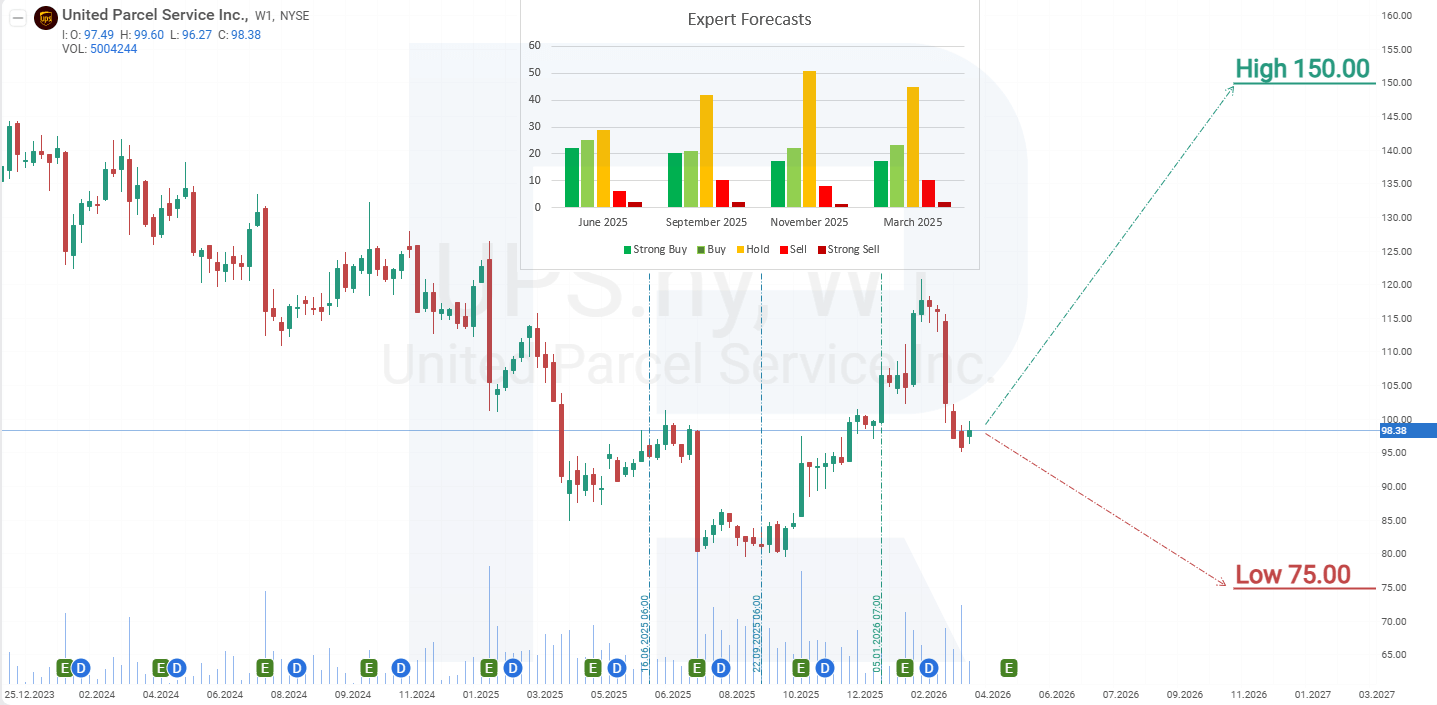
Expert forecasts for United Parcel Service, Inc. stock
- Barchart: 11 out of 28 analysts rated UPS shares as Strong Buy, 1 as Moderate Buy, 13 as Hold, 1 as Sell, and 2 as Strong Sell. The upper price target is 135 USD, and the lower bound is 75 USD.
- MarketBeat: 11 out of 28 analysts assigned a Buy rating, 14 recommended Hold, and 3 recommended Sell. The upper price target is 150 USD, and the lower bound is 75 USD.
- TipRanks: 9 out of 21 analysts rated the shares as Buy, 9 as Hold, and 3 as Sell. The upper price target is 135 USD, and the lower bound is 75 USD.
- Stock Analysis: 6 out of 20 experts rated UPS shares as Strong Buy, 2 as Buy, 9 as Hold, and 3 as Sell. The upper price target is 130 USD, and the lower bound is 75 USD.
United Parcel Service, Inc. stock price forecast for 2026
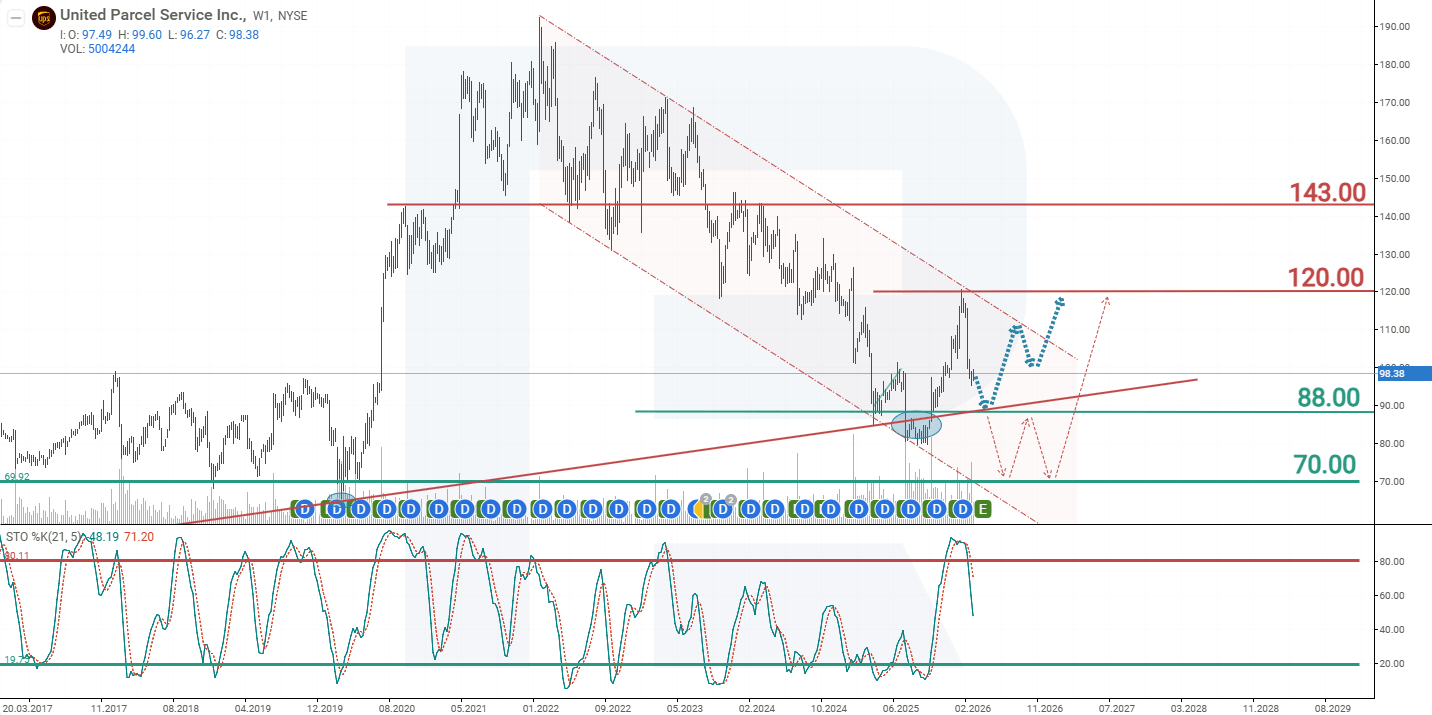
United Parcel Service shares continue to trade within a descending channel. The positive Q4 2025 results triggered a rally towards the trendline, where the upward momentum was exhausted. The Stochastic indicator signalling overbought conditions confirmed the likelihood of a correction, resulting in a roughly 20% decline from the local peak. Since the Stochastic has not yet reached oversold territory, further downside potential remains. Based on the current dynamics of UPS shares, the potential price scenarios for 2026 are as follows:
The primary forecast for UPS stock anticipates a test of support at 88 USD, followed by a rebound from this level and a rise towards 120 USD.
The alternative forecast for UPS shares assumes a break below the 88 USD support. In this scenario, the share price could decline to 70 USD, from which a resumption of the broader uptrend is expected. The main driver for this downside risk is a deterioration in the US macroeconomic environment, which could weaken consumer activity and reduce demand for logistics services.
Risks of investing in United Parcel Service, Inc.
stock
Investing in UPS stock entails several risks that may negatively impact its revenue and financial performance. The primary ones include:
- Economic cyclicality: demand for UPS logistics services is directly tied to overall economic activity. During recessions or periods of lower consumer demand, delivery and freight volumes decline, especially in the B2B and international trade segments.
- Rising costs (particularly labour and fuel): UPS is heavily reliant on labour and fuel. Rising diesel and aviation fuel prices, along with growing wages (driven, among other factors, by trade union contracts such as those with the Teamsters), may significantly reduce operating margins.
- Competition: the delivery market is becoming increasingly competitive. The major competitors – FedEx, DHL, Amazon Logistics, and national postal services – pursue aggressive pricing policies, invest in technology, and expand their infrastructure. Amazon, in particular, is actively developing its logistics, reducing its reliance on UPS as a contractor.
- Technology and operational disruptions: delays in delivery, IT system outages, cyberattacks, accidents, or inefficient logistics chain management may lead to losses, reputational risks, and customer attrition.
- Seasonality and dependence on peak periods: a significant portion of annual revenue is generated during holiday periods, such as Q4. Any disruptions during this period, such as adverse weather conditions, personnel shortages, or logistics delays, may have a disproportionate impact.
- Investment and capital expenditure: to remain competitive, UPS requires extensive modernisation of its fleet, IT infrastructure, and warehousing logistics. Mistakes in investment decisions or excessive capital intensity can reduce returns on invested capital.
Thus, despite its status as the industry leader, UPS is subject to various factors that may limit the company’s growth or reduce its financial resilience.
Forecasts presented in this section only reflect the author’s private opinion and should not be considered as guidance for trading. RoboForex bears no responsibility for trading results based on trading recommendations described in these analytical reviews.