
Nike – stabilisation signals emerge within downtrend.
Following the earnings release, Nike shares remain in a downtrend; however, early signs of potential growth are beginning to emerge. Nike is showing early signs of stabilisation in the wholesale channel, while Direct sales and China remain weak.
In 2026, the key level may be support at 30 USD, from which a rebound towards 78 USD is possible.
Nike, Inc. (NYSE: NKE) released mixed Q3 results for the 2026 financial year, which formally came in slightly above market expectations. Revenue totalled 11.28 billion USD, compared with a consensus of around 11.24 billion USD, while earnings per share reached 0.35 USD versus expectations of approximately 0.28 USD. However, in terms of quality, the quarter remained weak, as net income declined by 35% to 520 million USD and EBIT fell by 23% to 635 million USD.
On the positive side, the wholesale channel grew by 5% to 6.5 billion USD, while North America posted 3% growth, indicating early signs of business stabilisation. However, the higher-margin NIKE Direct segment declined by 4%, and digital sales fell by 9%, suggesting that the company is currently supporting revenue primarily through lower-margin sales.
An additional negative factor was the continued decline in profitability. Gross margin decreased by 130 basis points to 40.2%, primarily due to higher tariffs in North America, while Greater China remained a weak region, with revenue declining by 7%.
The company itself acknowledged that the turnaround is progressing more slowly than expected, and that inventory clearance, promotional activity, and competitive pressure continue to weigh on profit recovery.
The outlook for the next quarter was cautious. Nike expects revenue to decline by 2–4%, compared with market expectations of 1.9% growth, a 20% drop in sales in Greater China, and a further decline in gross margin of 25–75 basis points.
This article examines Nike, Inc., outlines the key sources of its revenue, summarises the company’s quarterly performance, and presents expectations for Q4 of the 2026 financial year. It also includes a technical analysis of NKE, which forms the basis for a forecast for Nike shares for the 2026 calendar year.
About Nike, Inc.
Nike, Inc. is a US-based company founded on 25 January 1964 by Phil Knight and Bill Bowerman under the name Blue Ribbon Sports before rebranding as Nike in 1971. The company designs, manufactures, markets, and sells athletic footwear, apparel, accessories, and equipment. Its primary business segment is athletic footwear, which generates most of its revenue. Nike produces goods for a variety of sports, including running, basketball, football, tennis, golf, and fitness.
The company was listed on the NYSE on 2 December 1980 under the ticker symbol NKE.

Nike, Inc.’s main revenue streams
Nike’s revenue is generated from various sources within its business operations, with a primary focus on key areas such as footwear, apparel, and equipment, as well as brand licensing and digital platforms. Nike’s main revenue streams are outlined below:
- Footwear sales: Nike’s largest source of revenue is footwear, including athletic sneakers, casual shoes, and specialised models for running, basketball, and fitness. In Q3 fiscal 2025, footwear remained the dominant category; however, quarterly data show a revenue decline in this segment, highlighting challenges related to excess inventory and competitive pressures.
- Apparel sales: this category encompasses sports and casual apparel, including T-shirts, shorts, tank tops, and outerwear. Apparel complements Nike’s footwear range and is a significant revenue stream, often related to seasonal demand and collaborations with sports companies.
- Sports equipment sales: Nike generates revenue from sports equipment, including bags, socks, gloves, and accessories. While smaller than the footwear and apparel segments, this category plays a supporting role in the brand’s ecosystem.
- Nike Direct: revenue from direct-to-consumer sales – including Nike’s website, mobile app, and physical stores –
falls under the Nike Direct segment. This channel prioritises direct sales to consumers, bypassing wholesalers. Digital sales remain a key focus for Nike, with continued investment in e-commerce.
Nike, Inc. Q3 2025 financial results
On 20 March, Nike released its Q3 2025 financial results for the quarter ended 28 February. Below are the key financial figures compared to the same period last year:
- Revenue: 11.27 billion USD (–9%)
- Net income: 0.79 billion USD (–32%)
- Earnings per share: 0.54 USD (–30%)
- Gross margin: 41.5% (–330 basis points)
Revenue by country:
- North America: 4.86 billion USD (–4%)
- Europe, Middle East, and Africa: 2.81 billion USD (–10%)
- Greater China: 1.73 billion USD (–17%)
- Asia Pacific and Latin America: 1.47 billion USD (–11%)
The company’s management attributed a 9% decline in revenue to a double-digit drop in sales in January and February, following a successful holiday season in December. China experienced the most significant slump, with sales falling by 17%. Despite growth in the workout and running apparel categories, Nike noted a decline in the sports style and Jordan brand segments, particularly in its classic footwear lines.
Nike’s management forecast a substantial revenue decline of 13.0–15.0% in Q4 of fiscal year 2025, ending on 31 May 2025, which exceeded analysts’ forecasts of 11.4–12.2%. The outlook reflected efforts to liquidate excess inventory and refresh outdated product lines amid external factors such as tariffs and economic uncertainty.
CFO Matthew Friend expected gross margin to decrease by 4–5 percentage points due to the active sell-off of old inventory and the introduction of new, innovative models, noting that Q4 fiscal 2025 would be the period with the most significant impact from these measures, after which pressure on revenue and margins was expected to ease in fiscal 2026.
Overall, Nike’s management described the quarter as a period of progress amid ongoing challenges, exceeding income expectations while continuing to face pressure on revenue and margins. For the upcoming quarter, they forecast a more substantial decline in sales and margins as part of a strategic business relaunch, with hopes for improvements in the fiscal year 2026.
Nike, Inc. Q4 2025 financial results
On 26 June, Nike released its Q4 2025 financial results for the quarter ended 31 May. Key financial figures compared with the same period last year are as follows:
- Revenue: 11.10 billion USD (–12%)
- Net profit: 0.21 billion USD (–86%)
- Earnings per share: 0.14 USD (–86%)
- Gross margin: 40.3% (–440 basis points)
Revenue by country:
- North America: 4.70 billion USD (–11%)
- Europe, Middle East & Africa: 3.00 billion USD (–9%)
- Greater China: 1.48 billion USD (–21%)
- Asia Pacific & Latin America: 1.58 billion USD (–8%)
Nike’s Q4 2025 report served as an indicator of a transitional phase in the company’s strategy. Despite weak financial results, management demonstrated confidence in the beginning of a recovery cycle. Revenue declined by 12% to 11.1 billion USD, and earnings per share fell by 86% to 0.14 USD. However, both figures exceeded market expectations and were positively received by investors.
Management identified Q4 as the low point in the implementation of the ‘Win Now’ transformation program. Inventory levels continued to decline, the retreat from aggressive discounting was underway, and the product portfolio was being reshaped with a focus on core sports categories. Under the leadership of new CEO Elliott Hill, management took steps to strengthen the brand’s position in key segments and reallocate internal resources.
The market responded to the report with a 14% rise in Nike shares. Analysts at JPMorgan, HSBC, Jefferies, and other investment houses raised their price targets, citing signs of a sustainable business turnaround.
For Q1 2026, Nike projected a mid-single-digit percentage decline in revenue, representing an improvement on previous market estimates. At the same time, the company anticipated gross margin compression of 350–425 basis points, driven by tariff costs and changes in the sales mix. According to CFO Matt Friend, Nike was prepared to offset up to 1 billion USD in additional tariffs by shifting some production out of China and introducing moderate price increases in the US, starting in autumn.
The restructuring strategy included personnel changes, a refocus on key product lines, optimisation of sales channels, and a return to a more sustainable distributor engagement model. The stabilisation of inventory levels (at approximately 7.5 billion USD) and growing interest in new collections confirmed positive momentum.
Despite continued revenue pressure in several regions (notably a 11% decline in North America and a 21% decline in China), the company was laying the groundwork for a gradual recovery in operational efficiency. With external risks easing and the planned initiatives being successfully implemented, Nike’s medium-term share price outlook was assessed as positive.
Nike, Inc. Q1 2026 financial results
On 30 September, Nike released its Q1 2026 financial results for the quarter ended 31 August. The key financial indicators, compared with the same period of the previous year, are as follows:
- Revenue: 11.72 billion USD (+1%)
- Net profit: 0.72 billion USD (–31%)
- Earnings per share (EPS): 0.49 USD (–30%)
- Gross margin: 42.2% (–320 basis points)
Revenue by region:
- North America: 5.02 billion USD (+4%)
- Europe, Middle East & Africa: 3.33 billion USD (+6%)
- Greater China: 1.51 billion USD (–9%)
- Asia Pacific & Latin America: 1.49 billion USD (+2%)
Nike’s quarterly report exceeded analyst expectations. Revenue totalled 11.72 billion USD, up 1% year-on-year and well above the expert forecast of 11.0 billion USD. Adjusted EPS came in at 0.49 USD, nearly double the expected 0.27 USD.
The stronger performance was driven primarily by the growth of wholesale sales and a recovery in demand in North America. Products in the running, training, and basketball categories performed particularly well. However, NIKE Direct sales fell by 4% year-on-year, while digital channel sales dropped by 12%. In China, demand remained weak, with no signs of improvement so far. Gross margin also declined to 42.2%, down 3.2 percentage points from the previous year, due to higher discounting, changes in channel mix, and rising costs, including customs tariffs. As a result, profitability declined, despite the strong figures for revenue and earnings per share.
For the upcoming quarter, Nike issued cautious guidance. The company expects revenue to fall by a few percentage points and gross margin to contract further by 3.0–3.75 percentage points, partly due to tariffs. Operating expenses (SG&A) in absolute terms are expected to continue rising, while the effective tax rate will be slightly above 20%. According to management, direct sales through Nike’s own channels are not expected to return to growth over the course of the 2026 financial year.
Nike, Inc. Q2 2026 financial results
On 30 September, Nike released its Q2 2026 financial results for the quarter ended 30 November. Below are the key financial metrics compared to the same period last year:
- Revenue: 12.43 billion USD (+1%)
- Net profit (non-GAAP): 0.99 billion USD (–29%)
- Earnings per share (non-GAAP): 0.53 USD (–32%)
- Gross margin: 40.6% (–300 basis points)
Revenue by country:
- North America: 5.63 billion USD (+9%)
- Europe, Middle East & Africa: 3.39 billion USD (–1%)
- Greater China: 1.42 billion USD (–16%)
- Asia Pacific & Latin America: 1.67 billion USD (–4%)
In Q2 2026, which ended on 30 November 2025, Nike’s revenue came in slightly above market expectations, but profit quality remained weak. Revenue stood at 12.43 billion USD, rising 1% year-over-year and exceeding the consensus. EPS reached 0.53 USD, also ahead of analysts' estimates.
The primary issue of the quarter was a sharp drop in profitability. Gross margin declined to 40.6%, down 3 percentage points from the previous year. Net profit fell by 32% to 792 million USD. According to the company’s non-GAAP data, operating profit dropped by nearly one-third, and operating margin fell to 8.0% from 11.3% a year earlier.
Sales structure shifted towards the wholesale channel, which grew by 8%, generating 7.5 billion USD in revenue, but this is a lower-margin business. NIKE Direct sales fell by 8%, with digital sales down 14% and branded stores down 3%. This suggests that the primary high-margin revenue source has not recovered, and revenue growth is driven by the less profitable channel.
Additional pressure came from regional dynamics. In Greater China, operating profit was nearly halved, and China continued to significantly drag down overall results. North America fared better, but still saw lower operating profit compared to the previous year.
The company directly explained the reasons for the margin decline: results were heavily affected by higher tariffs in North America, clearance sales to reduce inventories, and the restructuring of the product range and sales channels. At the same time, Nike increased marketing expenses by 13%. The CFO clarified that new tariffs add approximately 1.5 billion USD in annual costs, creating serious pressure on gross margin, which will not fully disappear in the coming quarters.
The forecast for Q3 2026 remains cautious. The company expects revenue to drop by low single digits, continued pressure on gross margin, and increased expenses due to marketing and investments.
Overall, while Nike continues to perform better than market expectations in terms of revenue, its margin and operating profit are deteriorating, and the company pre-warns of a challenging upcoming quarter due to tariffs and ongoing business restructuring.
Nike, Inc. Q3 2026 financial results
On 31 March, Nike released its Q3 2026 financial results for the quarter ended 28 February. Below are the key financial indicators compared with the same period of the previous year:
- Revenue: 11.28 billion USD (+0%)
- Net profit (non-GAAP): 0.52 billion USD (–35%)
- Earnings per share(non-GAAP): 0.35 USD (–35%)
- Gross margin: 40.2% (–130 basis points)
Revenue by country:
- North America: 5.03 billion USD (+3%)
- Europe, Middle East & Africa: 2.87 billion USD (+2%)
- Greater China: 1.62 billion USD (–7%)
- Asia Pacific & Latin America: 1.49 billion USD (+1%)
For Q3 of the 2026 financial year, Nike delivered mixed results. Revenue totalled 11.28 billion USD and remained broadly unchanged year-on-year, but was still slightly above market expectations of around 11.24 billion USD. Earnings per share reached 0.35 USD, also exceeding the consensus of 0.28 USD. In other words, the results formally came in above expectations, but it is still too early to describe this as a strong turnaround in the business.
The main issue of the quarter was again related to declining profitability. Gross margin fell to 40.2%, which is 130 basis points below the previous year’s level. Total NIKE, Inc. EBIT declined by 23% to 635 million USD, with EBIT margin falling to 5.6% from 7.3% a year earlier, while net profit fell by 35% to 520 million USD.
The sales structure remains weak. The wholesale channel grew by 5% to 6.5 billion USD, while the higher-margin NIKE Direct segment declined by 4% to 4.5 billion USD. Digital sales fell by 9%, and company-owned stores declined by 5%, indicating that revenue is being supported primarily by the less profitable wholesale segment.
By region, North America posted the strongest performance, with a 3% increase in revenue. However, Greater China remains the main weak point, where revenue declined by 7%. Management has already warned that in the current quarter, declining sales in China may deepen to 20% due to inventory clearance and pressure from local brands.
The outlook for Q4 of the 2026 financial year remained cautious. Nike expects revenue to decline by 2–4%, whereas the market had anticipated growth of 1.9% before the results. The company also warned that sales in Greater China may fall by 20%, while gross margin is expected to decline by a further 25–75 basis points. Overall, the conclusion for the quarter is straightforward: Nike is showing early signs of revenue stabilisation, but the market has yet to see a sustainable recovery in margins, direct sales, and the China business.
Analysis of key Nike, Inc. multiples
Below are the key valuation multiples for Nike, Inc. based on the results of Q3 of the 2026 financial year, calculated using a share price of 44 USD.
| Multiple | What it indicates | Value | Commentary |
|---|---|---|---|
| P/E (TTM) | Price paid for 1 USD of earnings over the past 12 months | 28.95 | ⬤ The stock appears expensive on an earnings basis |
| P/S (TTM) | Price paid for 1 USD of annual revenue | 1.40 | ⬤ On a revenue basis, valuation is moderate |
| EV/Sales (TTM) | Enterprise value to sales, accounting for debt | 1.40 | ⬤ In line with P/S due to net cash; a reasonable level for a global brand |
| P/FCF (TTM) | Price paid for 1 USD of free cash flow | 26.30 | ⬤ On an FCF basis, valuation is high |
| FCF Yield (TTM) | Free cash flow yield to shareholders | 3.80% | ⬤ Free cash flow yield is moderate |
| EV/EBITDA (TTM) | Enterprise value to operating profit before depreciation and amortisation | 17.51 | ⬤ A high multiple for a large consumer brand |
| EV/EBIT (TTM) | Enterprise value to operating profit | 23.05 | ⬤ On an EBIT basis, the picture is similar: the market is paying a high price for operating profit, with limited margin of safety in the multiples |
| P/B | Price to book value | 4.62 | ⬤ A significant premium to equity, though this is not unusual for a brand with a strong intangible component |
| Forward P/E | Forward price-to-earnings (P/E) ratio | 17.50 | ⬤ The market is pricing in a recovery in earnings, but not a deeply discounted valuation |
| Net Debt/EBITDA | Debt burden relative to EBITDA | ~0 | ⬤ The balance sheet shows net cash rather than net debt |
| Interest Coverage (TTM) | Ability to cover interest expenses with operating profit | not applicable | ⬤ The metric is not informative due to net interest income |
Valuation multiples analysis for NKE – conclusion
Nike shares can currently be viewed as a riskier play on a business recovery, rather than a purchase based on undervaluation. Based on current multiples, the stock appears expensive, as earnings and cash flow remain weak, while the market continues to assign a premium to the brand’s strength.
If Nike manages to restore margins, improve Direct channel sales, and return to earnings growth, the current valuation may, over time, appear justified, and the market could begin to re-rate the shares higher.
An additional positive factor is the absence of significant debt, which suggests the company’s financial position is not problematic even amid weak current results. This reduces the risk of a severe fundamental downside scenario, making the investment case more comfortable for those willing to tolerate volatility. Therefore, Nike shares at present represent more of a turnaround and recovery idea, where upside potential exists but is directly dependent on the company’s ability to deliver improved results in the coming quarters.
Expert forecasts for Nike, Inc. stock
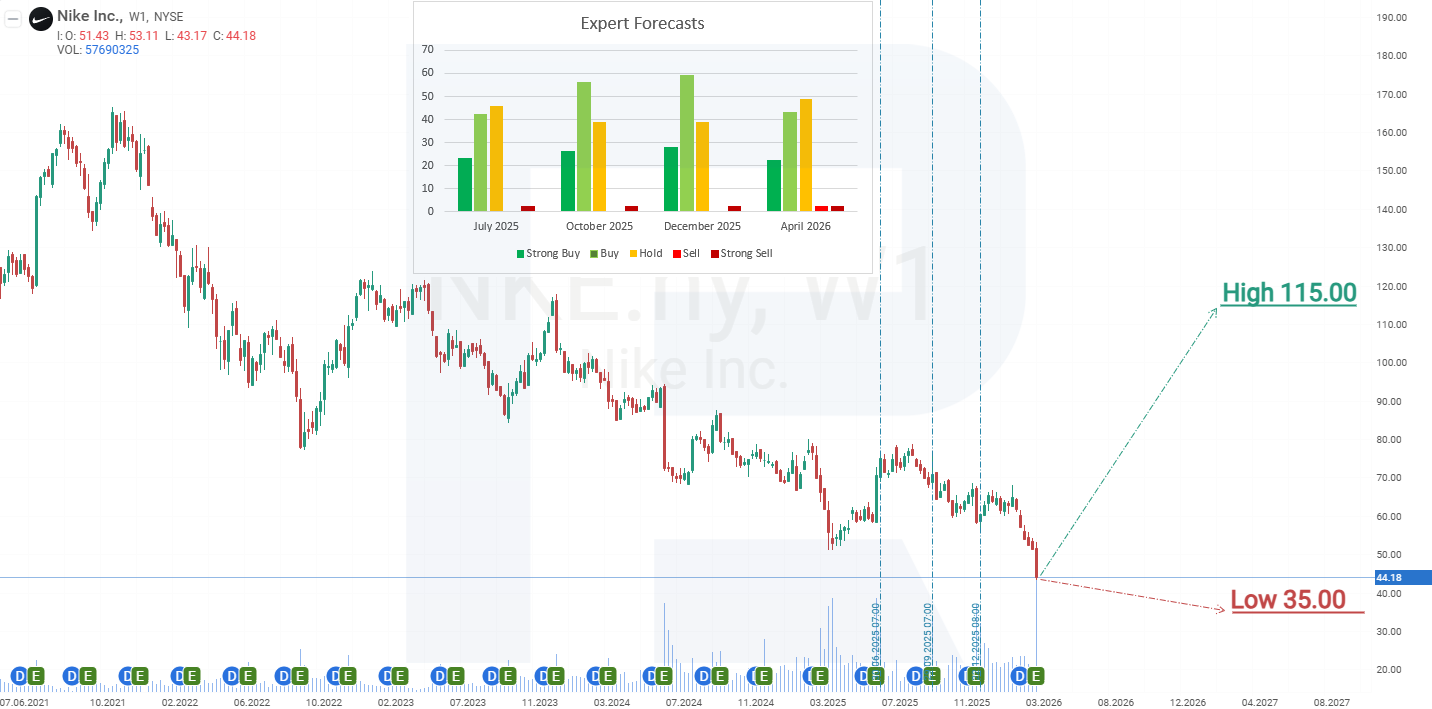
- Barchart: 15 of 36 analysts assigned a Strong Buy rating to Nike shares, 2 assigned a Moderate Buy rating, 17 assigned a Hold rating, and 2 assigned a Strong Sell rating. The upper price target is 120 USD, and the lower bound is 35 USD.
- MarketBeat: 19 of 33 analysts assigned a Buy rating to the stock, 13 gave a Hold recommendation, and 1 assigned a Sell rating. The upper price target is 115 USD, and the lower bound is 62 USD.
- TipRanks: 14 of 23 analysts assigned a Buy rating to the stock, and 9 gave a Hold recommendation. The upper price target is 90 USD, and the lower bound is 51 USD.
- Stock Analysis: 7 of 26 analysts assigned a Strong Buy rating to Nike shares, 8 assigned a Buy rating, 10 gave a Hold recommendation, and 1 assigned a Sell rating. The upper price target is 115 USD, and the lower bound is 62 USD.
Nike, Inc. stock price forecast for 2026
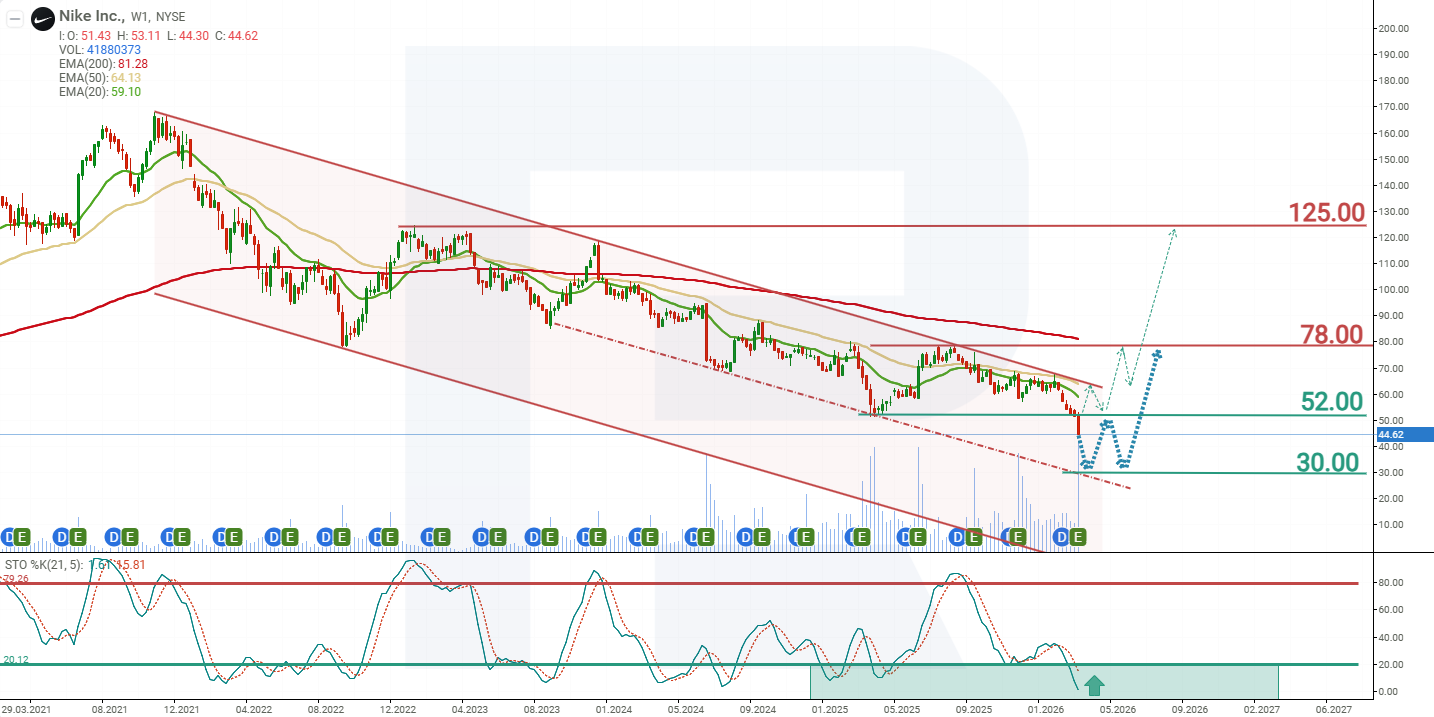
On the weekly chart, Nike shares have been trading within a descending channel since November 2021. Over the past five quarters, the company’s earnings have not returned to year-on-year growth; moreover, margins have continued to decline gradually, and management has indicated a further decline in its guidance. These factors continue to weigh on the stock, resulting in NKE shares breaking below support at 52 USD, marking the lowest level in seven years.
One positive aspect is the company’s strong financial position, which allows it to navigate the current challenging period without posing a threat to business stability. Based on the current performance of Nike shares, the possible scenarios for NKE in 2026 are as follows:
The base case forecast for Nike shares assumes further downside, with NKE expected to decline towards the channel line at 30 USD. At the same time, the Stochastic indicator is already in oversold territory, which may indicate a potential reversal to the upside. As a result, a rebound from the 30 USD level is expected, followed by a move higher towards 78 USD.
The alternative forecast for Nike stock assumes a break above the 52 USD level. This impulse could trigger further gains towards 78 USD. In the event of a breakout above this resistance, the next upside target would be 125 USD.
Risks of investing in Nike, Inc. stock
When investing in Nike, it is crucial to consider the risks that may negatively impact the company’s income and affect its investors. The main risks are outlined below:
- The impact of tariffs on profit margins: Nike has warned that higher tariffs on imports from China and Mexico could significantly reduce profit margins.
- Competition and loss of market share: Nike faces intense competition from brands such as New Balance and Adidas, which are strengthening their positions, particularly in casual footwear and retro model segments. This poses a threat to Nike’s market share.
- Economic instability: factors such as inflation, recession fears, and reduced purchasing power may lead to decreased consumer spending on sportswear and footwear, ultimately impacting Nike’s revenues.
Forecasts presented in this section only reflect the author’s private opinion and should not be considered as guidance for trading. RoboForex bears no responsibility for trading results based on trading recommendations described in these analytical reviews.