
USDJPY above 162.00: the market is awaiting action from the Bank of Japan
The yen is losing ground once again, and the Japanese government is preparing for intervention. The USDJPY rate currently stands at 162.20. Discover more in our analysis for 6 July 2026.
USDJPY forecast: key takeaways
- The threat of intervention from the Japanese government remains
- Investors are awaiting the release of the latest Federal Reserve meeting minutes
- USDJPY forecast for 6 July 2026: 161.80 and 163.00
Fundamental analysis
Fundamental analysis for 6 July 2026 shows that the pair is forming an upward wave towards the highs of 1986. On Monday morning, quotes are trading around 162.20, with the yen remaining under pressure despite the recent tightening of the Bank of Japan’s monetary policy.
The pair’s approach to the 162.00–163.00 levels has fuelled expectations that Japan’s Ministry of Finance may re-enter the market to support the yen. At the same time, it is worth noting that without a change in the fundamental factors, the effect of intervention may be short-lived.
Investors are awaiting the publication of the minutes of the latest Federal Reserve meeting and fresh inflation data, which may determine the Fed’s next steps and the pair’s direction.
The combination of a strong dollar and a weak yen remains the main driver of the USDJPY pair. The major risk for buyers is possible verbal or actual intervention by the Japanese authorities if the USDJPY rate rises above 162.00. At the moment, fundamental factors continue to support USD strengthening.
Technical outlook
On the H4 chart, the USDJPY pair formed a Hammer reversal pattern near the lower Bollinger Band and is trading around 162.20. Since the price remains within an ascending channel, it may continue its upward wave following the pattern signal, with the upside target at 163.20.
At the same time, the USDJPY forecast also takes into account another market scenario, with the rate potentially falling to the 161.80 support level before resuming growth.
USDJPY overview
- Asset: USDJPY
- Timeframe: H4 (Intraday)
- Trend: upward
- Key resistance levels: 162.42 and 163.00
- Key support levels: 161.80 and 159.80
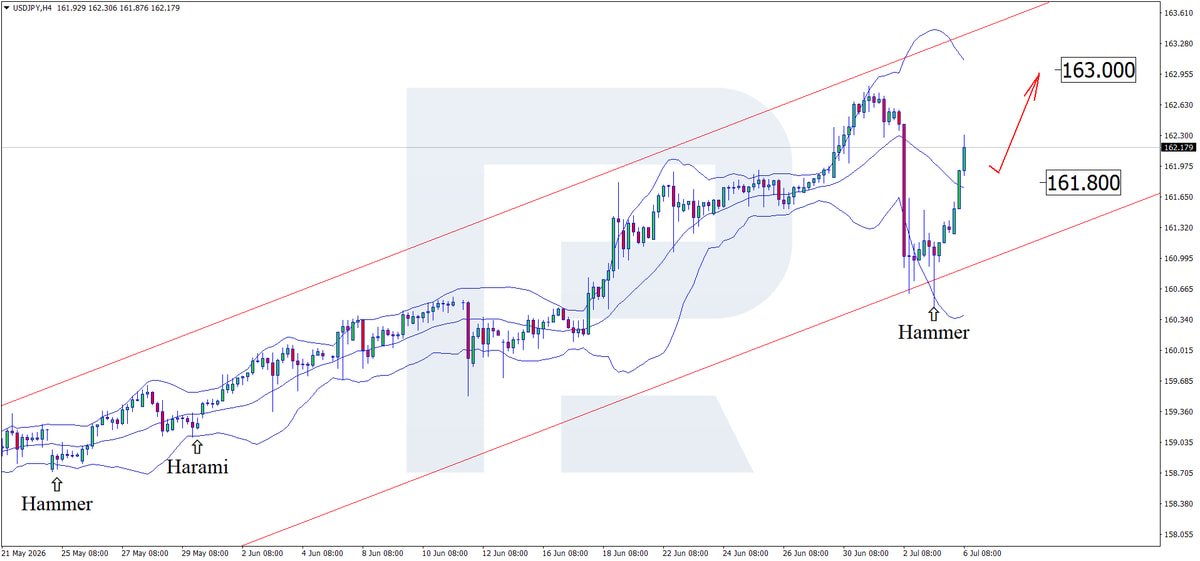
USDJPY trading scenarios for today
Main scenario (Buy Stop)
Consolidation above 162.42 would confirm the continuation of the uptrend and open the way to a test of the psychologically important 163.00 level.
- Take Profit: 163.00
- Stop Loss: 162.00
Alternative scenario (Sell Stop)
A breakout below the 161.80 support level would signal a corrective wave after growth and may lead to a decline towards 159.80 amid profit-taking and stronger expectations of currency intervention by the Japanese authorities.
- Take Profit: 159.80
- Stop Loss: 162.10
Risk factors
The main risk to the USDJPY upside scenario remains possible currency intervention by the Bank of Japan, which becomes more likely as the pair reaches new multi-year highs. An additional growth factor is softer Fed rhetoric, which may weaken the USD.
Summary
The yen continues to lose ground against the USD, and against this backdrop the Japanese government may carry out another intervention. Technical analysis of USDJPY suggests growth towards 163.00.
Editors’ picks
 EURUSD forecast 2026–2027: technical analysis, price levels & predictions
The ECB holds rates at 2.15% while the Fed stays at 3.75% — and that divergence is the central driver of EURUSD in 2026. The pair is range-bound between 1.1400 and 1.1915, with Deutsche Bank targeting 1.2500 and Morgan Stanley calling for 1.3000 by year-end. We analyse the technicals, break down the macro factors, and outline three trading scenarios with specific entry levels.
 Gold (XAUUSD) forecast 2026: predictions based on fundamental and technical analysis
Where is gold headed after pulling back from the all-time high of 5,597 USD? XAUUSD is consolidating near 4,518 USD between key levels 4,220 USD and 4,855 USD, with major banks targeting 5,243–6,200 USD by year-end. Read our comprehensive gold forecast: technical analysis across three timeframes, trading scenarios with specific entry levels, Fed policy and central bank demand outlook, and institutional predictions for 2026 and beyond.
Forecasts presented in this section only reflect the author’s private opinion and should not be considered as guidance for trading. RoboForex bears no responsibility for trading results based on trading recommendations described in these analytical reviews.