
EURUSD weekly forecast: new drivers are needed for the correction to continue successfully
The EURUSD pair enters the week of 6–10 July near 1.1443 after a confident recovery amid weak US labour market data. Expectations of a Federal Reserve rate hike in September fell to around 50%. The key event of this week will be the minutes of the June Fed meeting: they may adjust expectations for the US regulator’s future policy.
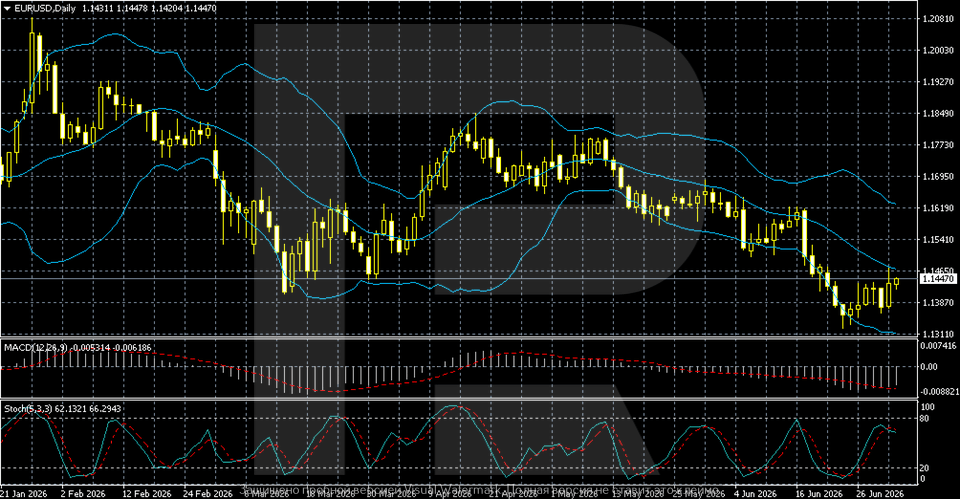
Technically, the EURUSD pair continues its corrective recovery after the June decline. The pair is hovering near 1.1450, but remains below the middle Bollinger Band, so it is premature to talk about a full-fledged trend reversal. The nearest resistance lies in the 1.1620–1.1700 zone, while the key support level remains at 1.1320. While quotes hold above 1.1450, the chances of a continued recovery remain.
EURUSD forecast for this week: quick overview
- Market focus: the EURUSD pair ended the week rising to 1.1443 amid a weaker US dollar. Despite strong JOLTS statistics at the start of the week, the ADP and Nonfarm Payrolls reports came in weaker than expected and forced the market to revise its forecasts for Federal Reserve policy. The likelihood of a September rate hike fell to around 50% from 67% a week earlier
- Current trend: on the daily chart, the EURUSD pair is developing a corrective recovery after the June decline. The pair climbed to 1.1450 but remains below the middle Bollinger Band. MACD is gradually reducing its negative values, reflecting a weakening bearish momentum. The Stochastic Oscillator has moved out of overbought territory, suggesting a short-term pause before a new move
- Weekly outlook: the baseline scenario remains a continued recovery, provided that the pair holds above the 1.1450 area. The nearest target for buyers is the 1.1620–1.1700 zone, with consolidation above it signalling a new uptrend. If the pair retreats below 1.1320, the risks of a renewed downward movement and a deeper correction will increase
EURUSD fundamental analysis
The EURUSD pair ended the week rising to around 1.1443. Weaker-than-expected US labour market data became the main factor pressuring the US dollar, as it forced the market to revise expectations regarding the Federal Reserve’s future action.
The week began with strong JOLTS statistics: job openings reached 7.594 million in May, above the forecast of 7.280 million. However, the ADP report then showed slower private sector employment growth, while the official Nonfarm Payrolls data ultimately changed market sentiment. In June, the US economy created only 57 thousand new jobs, falling short of the forecast of 110 thousand and marking the weakest increase in four months. The unemployment rate remained at 4.2%.
Following the data release, the likelihood of a Fed rate hike in September fell to around 50% from 67% a week earlier. Comments from Federal Reserve Chairman Kevin Warsh added to pressure on the dollar. He noted easing inflation expectations but also confirmed that restoring price stability remains the US regulator’s main priority.
This week, investors will shift their attention to the publication of the minutes from the June Fed meeting. The minutes will help assess how united the regulator’s officials were on the future interest rate path and whether they are ready for additional policy tightening if inflation risks persist. This document may become the main guide for the US dollar’s performance in the first ten days of July.
EURUSD technical analysis
On the daily chart, the EURUSD pair is forming a corrective recovery after a prolonged decline. The price rebounded confidently from the June low around 1.1320 and rose to 1.1450, but remains below the middle Bollinger Band, indicating that buyers managed to regain the initiative in the short term. However, it remains premature to talk about a full-fledged reversal of the long-term trend.
The technical picture is gradually improving. The nearest resistance level lies in the 1.1620–1.1700 area, where the upper boundary of the current correction passes and where selling has repeatedly intensified before. The support level is located in the 1.1320–1.1450 zone, which may become a base for further recovery after the upside breakout. While quotes hold above 1.1450, continued corrective growth remains highly likely.
Indicators confirm waning bearish momentum. MACD remains below the zero line, but the histogram is gradually reducing its negative values, signalling easing selling pressure. The Stochastic Oscillator has turned down after entering overbought territory, suggesting a short-term pause or a limited correction before the next move upwards.
In the medium term, the baseline scenario remains a recovery with an attempt to test the 1.1620 zone. However, only a firm consolidation above this resistance level will signal the formation of a new uptrend. Otherwise, the EURUSD pair may move into consolidation within the broad 1.1320–1.1620 range.
EURUSD trading scenarios
The EURUSD pair closed the week with gains, up to 1.1440 amid a weaker US dollar. The main driver was weaker-than-expected US labour market data. The probability of policy tightening in September fell to around 50% from 67% a week earlier. The key event of the new week will be the publication of the minutes from the June Federal Reserve meeting, which may adjust investor expectations regarding the future interest rate path.
From a technical perspective, the EURUSD pair remains in a corrective recovery phase after the June decline. The pair is hovering above 1.1450 but remains below the middle Bollinger Band, preventing a full-fledged reversal of the long-term trend. MACD is gradually reducing its negative values, confirming the weakening of the bearish momentum. The Stochastic Oscillator has left overbought territory, suggesting a short-term pause before a new move.
- Buy scenario
Consolidation above 1.1620–1.1700 would confirm a medium-term recovery and open potential for further growth.
- Sell scenario
A return below 1.1320 would signal the resumption of the downtrend and add to pressure on the euro.
Conclusion: the EURUSD pair improved its technical outlook due to dollar weakness following weak US labour market data. The minutes of the June Federal Reserve meeting and new signals regarding the US regulator’s future policy will largely determine the pair’s next direction.
Summary
The EURUSD pair ended the week advancing to 1.1443. Despite strong JOLTS statistics, the ADP and Nonfarm Payrolls reports indicated a cooling labour market, while the likelihood of a September rate hike fell to around 50%. The key event of the new week will be the minutes of the June Federal Reserve meeting.
Technically, the EURUSD pair has moved into a corrective recovery after the June decline. The pair is holding near 1.1450 but remains below the middle Bollinger Band, so it is premature to talk about a full-fledged reversal. The nearest resistance level lies in the 1.1620–1.1700 zone, while the key support remains the 1.1320 area.
Editors’ picks
 EURUSD forecast 2026–2027: technical analysis, price levels & predictions
The ECB holds rates at 2.15% while the Fed stays at 3.75% — and that divergence is the central driver of EURUSD in 2026. The pair is range-bound between 1.1400 and 1.1915, with Deutsche Bank targeting 1.2500 and Morgan Stanley calling for 1.3000 by year-end. We analyse the technicals, break down the macro factors, and outline three trading scenarios with specific entry levels.
 Gold (XAUUSD) forecast 2026: predictions based on fundamental and technical analysis
Where is gold headed after pulling back from the all-time high of 5,597 USD? XAUUSD is consolidating near 4,518 USD between key levels 4,220 USD and 4,855 USD, with major banks targeting 5,243–6,200 USD by year-end. Read our comprehensive gold forecast: technical analysis across three timeframes, trading scenarios with specific entry levels, Fed policy and central bank demand outlook, and institutional predictions for 2026 and beyond.
Forecasts presented in this section only reflect the author’s private opinion and should not be considered as guidance for trading. RoboForex bears no responsibility for trading results based on trading recommendations described in these analytical reviews.