
EURUSD awaits the Federal Reserve's interest rate decision
The EURUSD pair is being influenced by two opposing factors: persistently high interest rates in the US and mounting inflationary pressure in the eurozone. The rate currently stands at 1.1241. Discover more in our analysis for 22 October 2026.
EURUSD forecast: key takeaways
- According to an IMF assessment published on 16 October, the European regulator may need to raise interest rates by at least another 25 basis points
- According to Reuters data from 16 October, market participants estimated the probability of rates remaining unchanged at the October meeting at approximately 83%
- EURUSD forecast for 22 October 2026: 1.1360
Fundamental analysis
In the US, September inflation accelerated to 3.7% year-on-year, while core inflation, which excludes food and energy, rose from 2.4% to 2.6%, driven primarily by higher petrol prices. Meanwhile, the Producer Price Index (PPI), released on 15 October, rose by 1.3% month-on-month and 6.3% year-on-year, indicating that substantial inflationary pressure persists in the US economy.
In the eurozone, inflation reached 3.8%, up from 3.2% the previous month. Energy remains the main driver of price increases, although core inflation also rose to 2.5%. Rising energy costs present the ECB with a challenge: the regulator needs to curb inflation without adding to the pressure on economic growth.
The situation in France warrants particular attention, as it is currently one of the main factors weighing on the euro. Political instability, mass protests, and public finance problems have pushed the yield on ten-year French government bonds to 5%, its highest level since 2002. The spread between French and German government bond yields has widened considerably.
Technical outlook
On the D1 chart, the EURUSD pair has formed a resistance level at 1.1270 and a support level at 1.1150. The broader trend is sideways, with the potential for further gains and a breakout above resistance. On the H4 chart, support has formed at 1.1205, with resistance at 1.1250. The main upside target is 1.1360.
Today's EURUSD forecast also considers an alternative scenario. The price could break below the 1.1150 support level and reach 1.1070.
EURUSD overview
- Asset: EURUSD
- Timeframe: D1
- Trend: correction
- Key resistance levels: 1.1250 and 1.1270
- Key support levels: 1.1205 and 1.1150
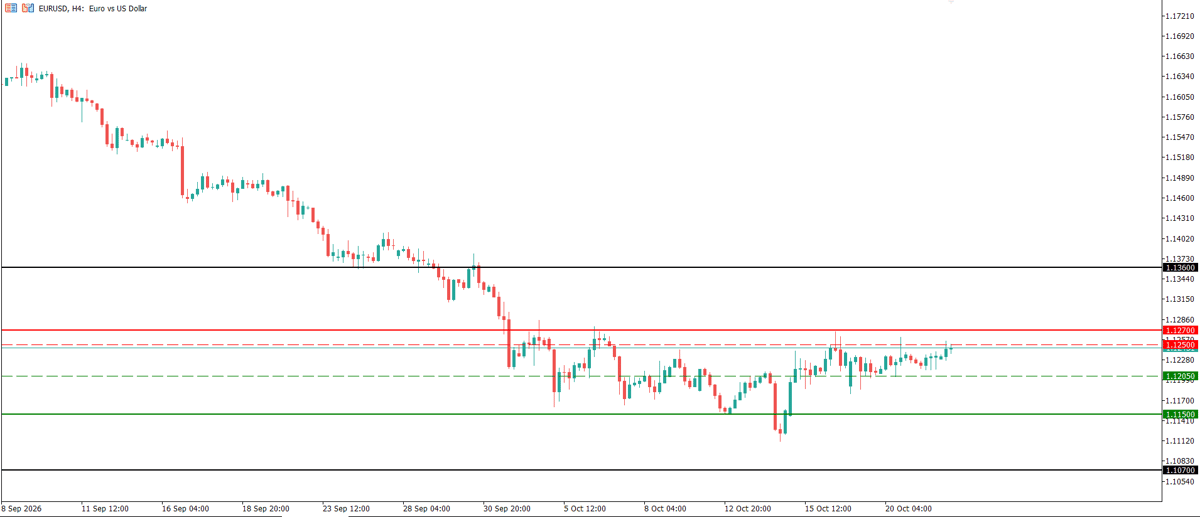
EURUSD trading scenario for today
A breakout above the local resistance level at 1.1250 would signal renewed bullish momentum and create conditions for opening long positions in EURUSD.
Risk factors
The main risk factors for the EURUSD pair remain uncertainty over the Fed and ECB’s future monetary policies, accelerating inflation in the US and eurozone, and slowing economic growth. A deterioration in Germany's economic situation, political instability in France, and rising energy prices could add to pressure on the euro. At the same time, a weakening US labour market and a possible softening of the Federal Reserve's rhetoric could cause the dollar to decline and lead to an upward correction in the EURUSD rate.
Summary
High interest rates in the US, deteriorating economic expectations in Germany, and financial instability in France are creating conditions for further pressure on the European currency. At the same time, slowing job growth in the US and uncertainty over the need for another Fed rate hike could limit dollar gains. A short-term corrective rise in EURUSD therefore cannot be ruled out.
Editors’ picks


EURUSD forecast 2026–2027: technical analysis, price levels & predictions
The EURUSD outlook for 2026 and 2027: key levels on the daily chart, three trading scenarios and the policy gap between the Fed and the ECB that drives the pair.

Gold (XAUUSD) forecast 2026: technical analysis, price levels & predictions
Where gold could trade in 2026: key levels, three trading scenarios with entry triggers and the forecasts from J.P. Morgan, Deutsche Bank and Goldman Sachs.
Forecasts presented in this section only reflect the author’s private opinion and should not be considered as guidance for trading. RoboForex bears no responsibility for trading results based on trading recommendations described in these analytical reviews.