
EURUSD weekly forecast: bears are getting stronger, but there is still a chance for growth
The EURUSD pair enters the week of 23–27 February after declining to 1.1755 amid a stronger US dollar. Robust labour market data and more hawkish signals from the Federal Reserve have reduced expectations for aggressive policy easing, although the market still prices in two rate cuts by the end of the year.
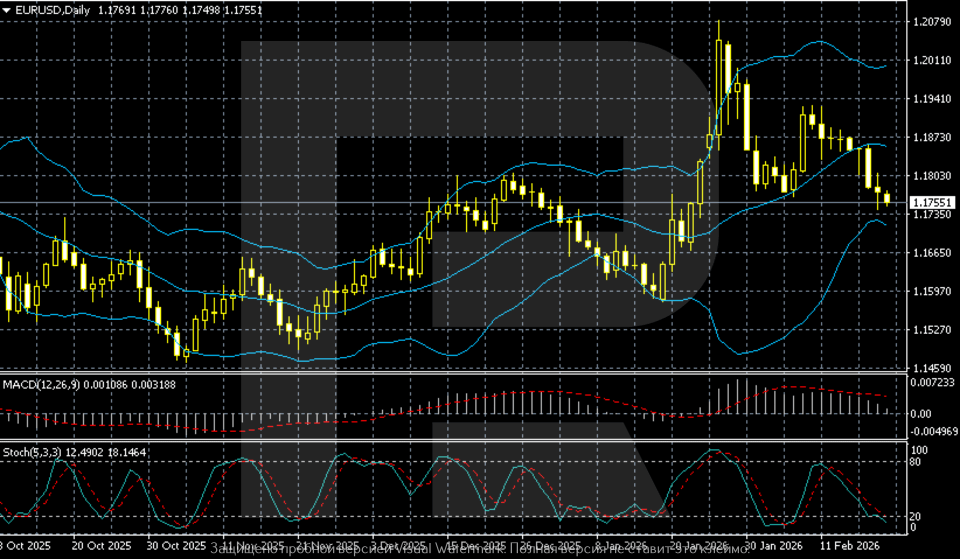
Technically, the EURUSD pair remains in a correction phase within a medium-term uptrend after the January impulse to 1.2050+. Holding the 1.1660–1.1700 support level maintains a moderately bullish scenario and the potential to return to 1.1870–1.2000. A breakout below this zone would increase the risk of a deeper decline towards 1.1520.
EURUSD forecast for this week: quick overview
- Market focus: the EURUSD pair fell to 1.1755 amid a stronger US dollar. Robust labour market data supported the US currency: initial jobless claims dropped to 206 thousand versus a forecast of 223 thousand, while continuing claims came in at 1.869 million, above expectations of 1.860 million. The Philadelphia Fed manufacturing index rose to a five-month high. At the same time, pending home sales fell by 0.8% m/m, and the Leading Economic Index declined by 0.2%. The FOMC minutes confirmed a split within the regulator, with some members allowing for further rate hikes. The market has lowered expectations for aggressive easing, but is still pricing in two 25-basis-point rate cuts by the end of the year
- Current trend: the daily chart shows a medium-term uptrend; however, after rising to 1.2050–1.2070, the pair moved into a correction, forming a series of lower highs. The price has shifted to the lower part of the recent weeks’ range and is approaching the middle line of Bollinger Bands, which are gradually narrowing. Although MACD remains in positive territory, momentum is weakening. The Stochastic Oscillator points to the risk of continued short-term pressure
- Weekly outlook: the baseline scenario suggests a continued correction within the uptrend if the 1.1660–1.1700 support zone holds. A breakout below this area will increase the risks of a move towards 1.1520. The resistance level is located around 1.1870 and then 1.2000
EURUSD fundamental analysis
The EURUSD pair settled at 1.1755, with the US dollar supported by robust macroeconomic data and more hawkish signals from the Fed.
The labour market confirmed resilience: initial jobless claims fell to 206 thousand versus expectations of 223 thousand (previously 227 thousand). Continuing claims came in at 1.869 million compared to expectations of 1.860 million. In addition, the Philadelphia Fed manufacturing index unexpectedly rose to a five-month high.
At the same time, some data was weaker. Pending home sales in January fell by 0.8% m/m, missing expectations for a 1.4% increase (previously -7.4%). The Leading Economic Index fell by 0.2% in December, matching the forecast.
The minutes of the latest FOMC meeting confirmed a split within the regulator. Some members allow for the possibility of further rate hikes if inflationary pressure persists. Federal Reserve Governor Stephen Miran noted that he now expects a less dovish rate path amid resilient employment and inflation in the goods sector.
Investors have scaled back their expectations for aggressive policy easing, but still price in two 25-basis-point rate cuts by the end of the year.
EURUSD technical analysis
On the daily chart, the EURUSD pair remains in a medium-term uptrend, but after a momentum-driven rally to 1.2050–1.2070, it moved into a correction phase. A series of lower highs has formed from the January highs, indicating weakening bullish momentum.
Quotes are now trading around 1.1750–1.1760, moving towards the lower part of the recent weeks’ range. The price has approached the middle Bollinger Band, while the bands themselves have started to narrow gradually – volatility is declining after the sharp move.
MACD remains in positive territory, but the histogram is shrinking, signalling a slowdown in upward momentum. The Stochastic Oscillator is near oversold territory and turning downwards, suggesting continued pressure in the short term.
The nearest support level is located in the 1.1660–1.1700 area, with the next one at 1.1520. The resistance level is 1.1870, followed by 1.2000. As long as the pair holds above 1.1660, the uptrend structure formally remains, but the market has moved into a correction phase.
EURUSD trading scenarios
The EURUSD pair edged lower to 1.1755 amid a stronger US dollar following robust macroeconomic data and more hawkish signals from the Federal Reserve. Initial jobless claims fell to 206 thousand compared to expectations of 223 thousand (previously 227 thousand), while continuing claims totalled 1.869 million, above the forecast of 1.860 million. The Philadelphia Fed manufacturing index rose to a five-month high. At the same time, pending home sales fell by 0.8% m/m versus expectations of a 1.4% increase, and the Leading Economic Index declined by 0.2%. The FOMC minutes confirmed a split within the regulator, with some members allowing for further rate hikes. The market has reduced expectations for aggressive easing, but still prices in two 25-basis-point rate cuts by the end of the year.
- Buy scenario
Holding the 1.1660–1.1700 support zone keeps the potential for stabilisation and a return to 1.1870–1.2000 within the medium-term uptrend.
- Sell scenario
A breakout below 1.1660 would increase the risks of a deeper correction towards 1.1520.
Conclusion: the baseline scenario suggests movement within a correction range with a moderately bearish bias while maintaining the uptrend structure above 1.1660.
Summary
The EURUSD pair fell to 1.1755 as the US dollar strengthened following strong US labour market data and more hawkish signals from the Federal Reserve. Initial jobless claims dropped to 206 thousand versus a forecast of 223 thousand, and the Philadelphia Fed manufacturing index rose to a five-month high. The FOMC minutes confirmed a split within the regulator and reduced expectations for aggressive policy easing.
Technically, the EURUSD pair remains in a correction phase within a medium-term uptrend after the January rally to 1.2050+. The price is trading in the 1.1750–1.1760 zone, momentum is weakening, and volatility is declining. The key support level is located at 1.1660–1.1700, with resistance at 1.1870 and 1.2000. As long as the pair holds above 1.1660, the uptrend structure remains, but the market is in a consolidation phase.
Editors’ picks
 EURUSD 2026-2027 forecast: key market trends and future predictions
This article provides the EURUSD forecast for 2026 and 2027 and highlights the main factors determining the direction of the pair’s movements. We will apply technical analysis, take into account the opinions of leading experts, large banks, and financial institutions, and study AI-based forecasts. This comprehensive insight into EURUSD predictions should help investors and traders make informed decisions.
 Gold (XAUUSD) forecast 2026 and beyond: expert insights, price predictions, and analysis
Dive deep into the Gold (XAUUSD) price outlook for 2026 and beyond, combining technical analysis, expert forecasts, and key macroeconomic factors. It explains the drivers behind gold’s recent surge, explores potential scenarios including a move toward 4,500 to 5,000 USD per ounce, and highlights why the metal remains a strong hedge during global uncertainty.
Forecasts presented in this section only reflect the author’s private opinion and should not be considered as guidance for trading. RoboForex bears no responsibility for trading results based on trading recommendations described in these analytical reviews.